Is It a Test or a Flight?
By Peter Plötner · · 8 min read
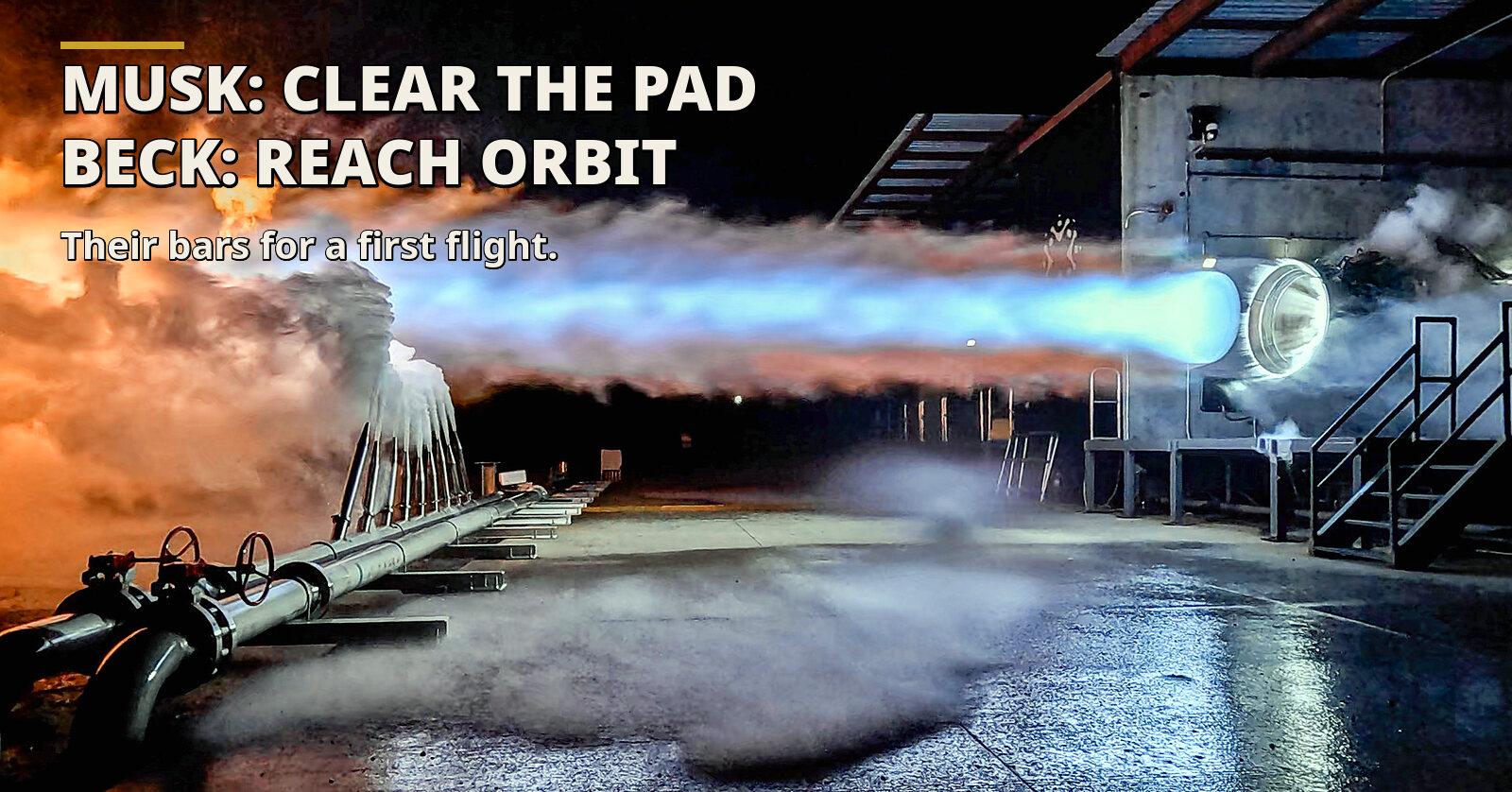
Rocket Lab found tiny air pockets in a part made for its new rocket and moved the first launch to 2027 to build it again. SpaceX flies its early Starships as tests. Both make sense once you know which one you are running.
By Peter Plötner. Aerospace engineer and Wayfinder Life Coach. More about Peter →
Rocket Lab found tiny air pockets inside a part made for its new Neutron rocket. On October 14, founder Peter Beck moved the first launch to 2027 to build that part again.
If you lead a company, the sentence that usually ends this kind of argument is a short one: it probably won't fail.
Air in the thick parts
Neutron is the big rocket Rocket Lab has been building since 2021, first meant to fly in 2024. It is made to land its first stage and fly again. Its structure is carbon composite: thin layers of carbon fiber held together with resin. At room temperature, that is stronger for its weight than steel or aluminum. But Neutron burns liquid oxygen and liquid methane, both colder than minus 160 degrees Celsius, and stainless steel gets stronger in that kind of cold, so carbon's lead shrinks. Heat works against carbon too, because the resin softens. SpaceX first planned Starship in carbon fiber and switched to stainless steel, partly for those reasons.
In January, the first full-size tank for Neutron's first stage burst in a pressure test. An outside company had made that tank by hand, so the work could go on while Rocket Lab set up its own big machine, a robot that lays the carbon fiber down. Rocket Lab later said the tank had held the loads of a real flight. Then, as the test pushed on past those loads to check the extra strength, it burst at a weak joint, a flaw Beck blamed on the hand work.
So Rocket Lab moved the work to its robot. The robot let the engineers remove some joints and make parts of both tank domes thicker, for strength. The domes are the rounded caps on each end of the tank.
Recently, inspectors checked a newly made forward dome, the cap on the top end, after it had been cured. They found voids: tiny air pockets between the layers of carbon fiber. The voids sat in exactly the new, thicker parts.
There's a reason the air collected there. Curing uses heat and pressure to harden the resin. At the same time, they have to push resin through every layer and push the air out. The thicker the part, the harder that gets.
Possible success
In the video where he explained the delay, Beck said the voids “don't necessarily mean that the dome would fail on flight, but our practice is to proceed only when we believe the system has the appropriate margins.” He added: “Possible success isn't our standard.”
A tank is built to hold more than any flight should ever ask of it. Engineers call that extra the margin. It is there for what nobody can predict exactly: a load a little higher than planned, a part a little weaker than its drawing. A void makes the extra smaller, even if the dome would never burst on a normal flight. So a part can probably survive its flight and still not be ready to fly. “Probably” is a guess about the flight you planned, and the margin is for everything you did not plan.
In aerospace, a part that misses its standard can't fly until the team has shown it is still good enough, or replaced it. That is normal practice. What stands out is how plainly Beck said it, in public, knowing what it would do to the schedule. The first launch moved from late 2026 into 2027, and the next day Rocket Lab's shares closed 6.6 percent lower.
Building it again
The voids sat inside the strength Rocket Lab had added after January. A fix is a new part, and it can go wrong in its own new way, so it needs the same checks as every other part.
Rocket Lab's team made the voids appear again on purpose, in tests, and changed the process so they stop forming. The matching aft dome, the cap on the bottom end, has already come through the new process. Beck called it “the highest quality carbon composite dome to date.”
A new forward dome is being built on the same robot now. It will be checked with ultrasound for voids. Then the whole first stage gets assembled and tested, first with water under pressure and then with super-cold liquids. Beck expects that to be done within the first 3 months of 2027, and plans to name a launch date only after that.
A test or a flight
Beck does change his mind. He once said Rocket Lab would not reuse rockets or build bigger ones, and promised to eat his hat if it ever did. In March 2021, in the video that revealed Neutron, a reusable rocket far bigger than Electron, he put a Rocket Lab cap through a blender and took a bite of it from a martini glass.
Since then, he has been careful about promises. That December, he called Neutron “probably the last rocket I'll ever design,” and added: “Who knows.” In 2024, asked whether another rocket would come after Neutron, he said he did not want to eat another hat, so he had learned to say “never say never.”
On what counts as a first flight, though, he hasn't budged, and SpaceX stands on the other side of that line. Before Starship's first flight in April 2023, Elon Musk said: “If we get far enough away from the launch pad before something goes wrong, I would consider that to be a success.” In August 2025, Beck told investors they would not hear “some rubbish about just clearing the pad” called a success for Neutron. Later that year he said the aim is to reach orbit on the first try.
Both companies test on the ground until things break, which is normal practice. In 2020, SpaceX pushed a Starship test tank until it burst. Rocket Lab fires its Neutron engines on test stands in Mississippi, and one of its tanks burst in January. The difference is where each one draws the line between a test and a flight. SpaceX treats early Starship flights as tests too, and a test is judged by what it teaches, so a flight that ended early could still do its job. On September 28, Flight 14 reached orbit. Rocket Lab once drew the line in the same place: its first Electron launch, in 2017, was called “It's a Test.” For Neutron, Beck has put the first launch on the flight side of the line. A test can fail and still have done its job. A flight needs more than a chance of working: it needs the margin it was designed with.
The dive I took on “probably”
I once let “probably” decide a cave dive.
Cave divers plan their air with the rule of thirds: a third to swim in, a third to swim out, a third kept in reserve. That day our tanks weren't balanced. If the bigger tank failed, the smaller one alone had to get you out, and by that count we were planning to go much too far in. I argued it hard and lost to 3 divers with more experience than me. Then I made my own call. I judged we would probably not lose more than 2 full tanks, and that the 4 of us together had enough margin to get everyone out. So I went.
On the way out, 10 minutes from the exit, the air in the tank I was breathing from ran dry, right where my argument had said it would. I had 2 good tanks of my own. I switched to one and swam out.
That day, “probably” was my standard, and my own 2 tanks were the margin. Without them, that spot is where I would have died.
Your tests and your flights
Your work has both. A pilot with one friendly customer is a test, and so is a new way of pitching. What counts there is what you learn, and a failure still teaches you something. A promise to a customer whose business runs on your product is a flight. So is the quarter you plan on 5 hours of sleep a night. For those, “it probably won't fail” is the guess Beck refused, and the margin is what gets you through the week that doesn't go as planned.
Most of a week can run as tests, which takes pressure off. It also leaves room to give the real flights their margin.
Beck's bar was in place before anyone found a void. That is the part worth copying: decide which of your things are flights, and how much margin each one needs, before the week that tests it.
Which part of your work would you hold to a flight's standard?
Frequently asked questions
Why did Rocket Lab delay Neutron's first launch to 2027?
On October 14, 2026, Rocket Lab said inspectors had found voids, tiny air pockets, between the carbon fiber layers of a newly made forward dome for Neutron's first-stage propellant tank. The voids formed in sections that had been made thicker for strength after a test tank burst in January, because thick sections are harder to cure cleanly. Rocket Lab chose to build a new dome instead of flying that one. Finding the cause, fixing the process and building the new part moved the first launch from late 2026 into 2027.
Would the dome have failed in flight?
Not necessarily, and Peter Beck said so himself. But Rocket Lab only goes ahead when it believes the system has enough margin: the extra strength a part has beyond what a flight should ask of it, kept for loads and weak spots nobody can predict exactly. Voids make that extra smaller.
Was the problem in Neutron's nose?
No. Neutron's nose is the “Hungry Hippo” fairing, which opens like a pair of jaws to release the second stage and stays attached to the first stage. Rocket Lab announced in December 2025 that it had passed its qualification tests. The voids were in a different part, the forward dome of the first-stage propellant tank.
How is Rocket Lab's approach different from SpaceX's?
Both companies test parts on the ground until they break, which is normal in the industry. The difference is how each treats its first flights. SpaceX flies early Starships as tests to learn from; before the first one in 2023, Elon Musk set the bar at getting clear of the launch pad. Rocket Lab flew its first Electron as a test in 2017, but for Neutron, Beck has said the first flight should reach orbit. A test is judged by what it teaches and a flight by whether it works with its margin intact, so the two approaches fit different jobs.
When will Neutron launch now?
Rocket Lab hasn't set a date. Beck laid out the steps: build the new forward dome, cure it and check it with ultrasound and other inspections, then assemble the first stage and run the water pressure (hydrostatic) and cryogenic test campaigns. He expects to finish them within the first quarter of 2027 and to share a target launch date after that.
Two companions: What Did You Put on the Test Stand This Week? on the number Beck told investors to watch instead of the launch date, and Nothing Went Wrong for Ten Years, the full story of that cave dive. If you want a first reading on where your own life is running on somebody else's requirements, the Spec Check is 4 questions and takes about a minute.
Related essays
Your space, free
No matter where you start, it walks with you: find what you really want, and be at peace and in joy on the way. Your unfair advantage.
Make my free account