Stop Collecting Moves
By Peter Plötner · · 6 min read
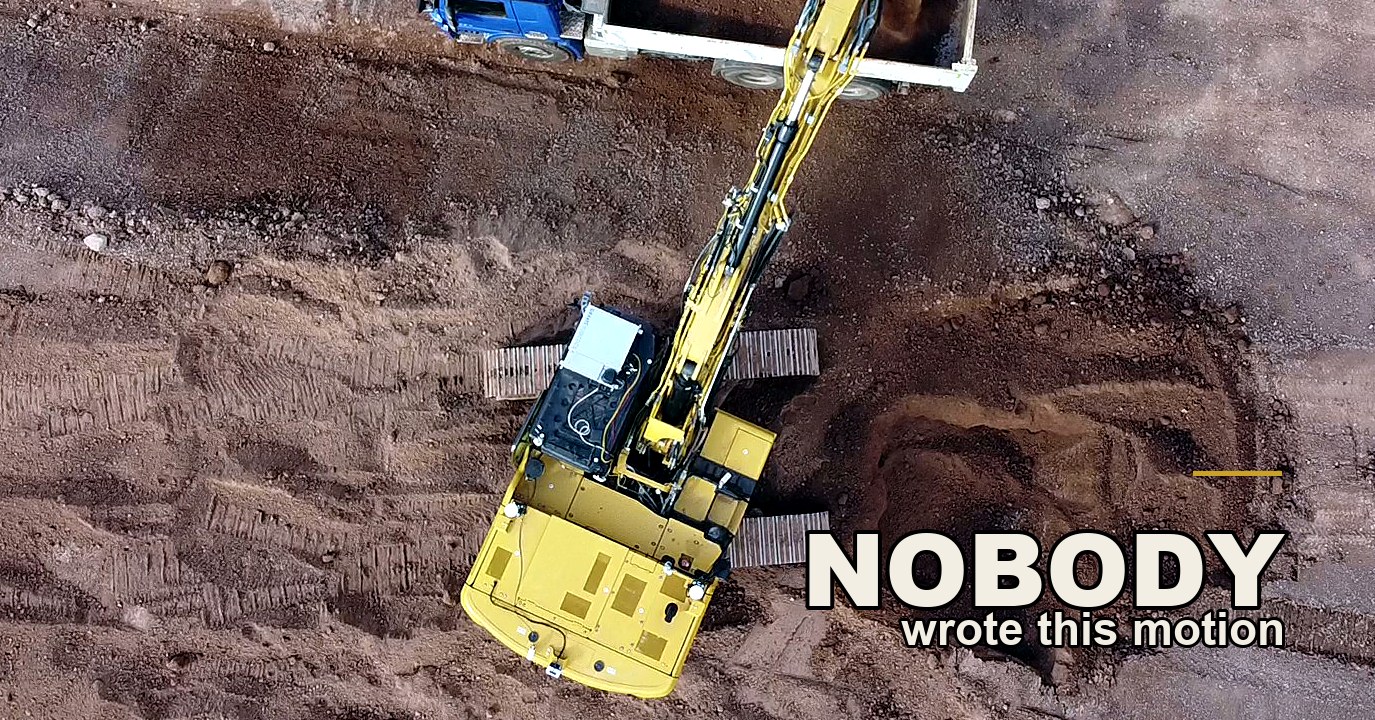
Nobody programmed the motion, because no motion would have worked. So they taught the layer above it, and that turns out to be the only part that survives a change in conditions.
By Peter Plötner. Aerospace engineer and Wayfinder Life Coach. More about Peter →
SoftBank just put $200M into machines nobody taught how to dig.
The money went to Gravis Robotics, a 4-year-old spinout from ETH Zurich, and SoftBank is the only investor in the round. Gravis sells a rack of sensors and computers that bolts onto excavators a contractor already owns: Caterpillar, John Deere, Volvo, JCB, Hitachi and several more brands of iron. The company calls it the largest Series A in construction robotics.
Their number is up to 30% more throughput with terrain-aware excavation.
No motion was programmed in. No motion can be.
You cannot record the motion
The first industrial robot went to work at a General Motors plant in 1961, lifting hot metal castings off a die-casting line. You recorded the joint positions once and played them back for years. That works because the part arrives identical every time. A factory is a building whose entire purpose is to make the world repeat.
Now the excavator. One bucket is wet clay that sticks to the sides. The next is loose gravel that runs out from under itself. Below that is ground still frozen from last week, and somewhere in there is a rock nobody put on the survey. The force it takes to cut depends completely on what you are cutting, so the same commanded bucket path removes a different amount of material every pass.
You could try to record a motion for every situation. That fails, and not because the list is long. It fails because you cannot see the list.
What the lab taught instead
Marco Hutter runs the Robotic Systems Lab at ETH Zurich and is a co-founder of Gravis. Before any of this became a company, his lab published something worth reading slowly.
They have a 4-legged robot called ANYmal. They never gave it a gait. They trained its controller in simulation, a virtual training camp full of obstacles and errors, then sent it outside. In 2022 it walked a hiking trail on Mount Etzel near Lake Zurich, 120 meters of climb, in 31 minutes. The signpost estimate for people is about 35. No falls, no missteps.
Then read what they say it learned, because it is not where to put a foot.
It learned when to trust its own reading of the ground and move briskly, and when to slow down and take small steps.
Its eyes can be wrong. Tall grass reads as solid floor. Snow hides a step. So the robot carries a second sense, what its legs actually feel on contact, and the thing it was taught is how much to believe its eyes.
That sits a level above any movement. It is a rule for choosing one.
938 stones and no plan
The same lab took a modified walking excavator called HEAP and had it build a dry-stone wall: 65 meters long, 6 meters tall at its highest point, out of 938 boulders and chunks of demolition concrete averaging more than 1,000 kg each. Science Robotics published that one in November 2023.
Dry stone means no mortar. It stands on friction and fit alone, so the fit has to be right.
Every stone was a different shape, which means there was no plan and there could not be one. The machine picked each one up, scanned it, worked out where that particular stone would sit, and set it down. Measure this one, then decide. 938 times.
Nobody handed it a wall. They handed it a way of deciding, and a wall came out.
You have been collecting moves
Now the part that has nothing to do with robots.
If you are a technical founder, you own a library of moves. The pricing change that worked. Your hiring bar. How you run the Monday. The order you ran the last raise in. What you did after the bad hire.
A move is a recorded motion, and every one of them carries unnoticed prerequisites: 6 people, that market, that much runway, that co-founder, you at that age.
Then the prerequisites change and the move stops paying. Nothing about it got worse. It was your own move, earned, and it went quiet on you.
And the reflex is to go and get more moves. Another book, another podcast, another founder dinner. Which makes sense, because a shortage of moves and a shortage of deciding feel identical from the inside.
The layer above, taken apart
People call this a meta skill, the skill of picking which skill to use. The label does no work on its own. What matters is that it comes apart into 3 things you can practice, and I did not expect that when I started looking.
A reading, on two channels. The robot has its eyes and it has its legs. You cannot choose a move for conditions you have not measured, and the channel most of us skip is the one that arrives through the body. When I started coach training I sat on a call with 10 coaches who read themselves in high resolution. I had 2 channels. Tight chest, less tight chest. It got better because I started writing the readings down, not because I tried harder.
A trust setting. This is the one from the mountain. When the read is clear, move briskly. When the read is vague, shorten the step. Step size is a separate decision from direction, and it is the one the robot was trained on explicitly.
A cheap place to be wrong. The controller learned in simulation, where falling over costs nothing and you can do it a million times. This is the leg almost nobody has. Your trials happen live, in front of the team, the board and the customer.
Where the reps come from
The useful part of that simulation was volume. Thousands of tries at deciding, before any single decision mattered.
More volume is available than it looks, and not because a higher number is easier. Raising the count is what forces the process to improve. A rocket engine line building 400 engines a year has fewer defects per engine than one building 20, because at 400 you cannot carry the sloppy steps. Run a decision weekly instead of once a quarter and the same pressure arrives. You stop being able to afford a vague reading.
So the lever is frequency. Smaller decisions, more often. The choice said out loud before it goes live. The reading written down, then checked later against what actually happened.
One reading
Take a move that has stopped paying. Do not do more of it, and do not go looking for a replacement.
Write down what was true when it started working. Team size, money, market, who you were. Then write what is true now. The gap between those two lists is your reading.
Then set your step size to match how clear that reading came out.
What would be a meta skill for you, one that would improve your daily life?
Frequently asked questions
What is a meta skill?
It is a skill for choosing and adjusting other skills, rather than a skill for doing one thing. Digging a trench is a skill. Working out which cut this ground calls for, and how fast to commit to it, is the layer above. The reason it matters more than any single move is that a move carries the conditions it was learned under, and those conditions change while the move stays the same.
What did the ETH Zurich robot actually learn, if not how to walk?
According to the researchers, it learned to combine what its cameras see with what its legs feel, and to judge when to trust the visual read and move briskly versus when to proceed cautiously with small steps. Its controller was trained in simulation across many obstacles and errors first. On a trail up Mount Etzel it climbed 120 meters in 31 minutes, faster than the signposted human estimate of about 35, with no falls.
Why do playbooks and tactics stop working?
Because a playbook is a recording, and it was made under prerequisites nobody wrote down: the team size, the market, the money in the bank, the person you were. Those move quietly. The playbook does not get worse, it just stops matching, and from the inside that feels the same as needing a better playbook. Which is why the usual response is to collect another one.
How do you practise deciding instead of doing?
Separate the two, then raise the frequency. Say the choice out loud, in front of somebody with no stake in the outcome, before it is live. Write down your reading of the situation and how confident it is, then check it later against what happened. Making the decisions smaller and more frequent is what forces the process to sharpen, the same way a higher build rate forces a factory to.
Isn't this just experience?
Experience reliably builds the move library. It does not automatically build the layer above it, which is why you meet people with 25 years of moves and a thin sense of which one this moment wants. The deciding layer needs its own practice: a real reading, an honest confidence level attached to it, and somewhere cheap to be wrong. None of that is a gift. It comes apart into parts you can train, which is the good news buried in the whole thing.
One thing that closes soon. I just earned my certification as a Wayfinder coach, and to mark it I am giving away my full 3 month coaching package to 1 person, free. It is the same package paying clients get: a session every 2 weeks, support in between by message or voice, and the method itself, so you can run it again on your own later. No homework. I read every application myself and they close on September 20. If the question in this essay is live for you right now, the application is here and takes about 5 minutes.
The companion pieces are The Answer Was 42 on why an answer that fits you can still cap you, and Fail Faster to Get There Sooner on making the trials cheap enough to run often. If you want a first reading on two channels, the Spec Check is 4 questions and takes about a minute.
Related essays
Your space, free
No matter where you start, it walks with you: find what you really want, and be at peace and in joy on the way. Your unfair advantage.
Make my free account