Some Things Only Show Up in Flight
By Peter Plötner · · 6 min read
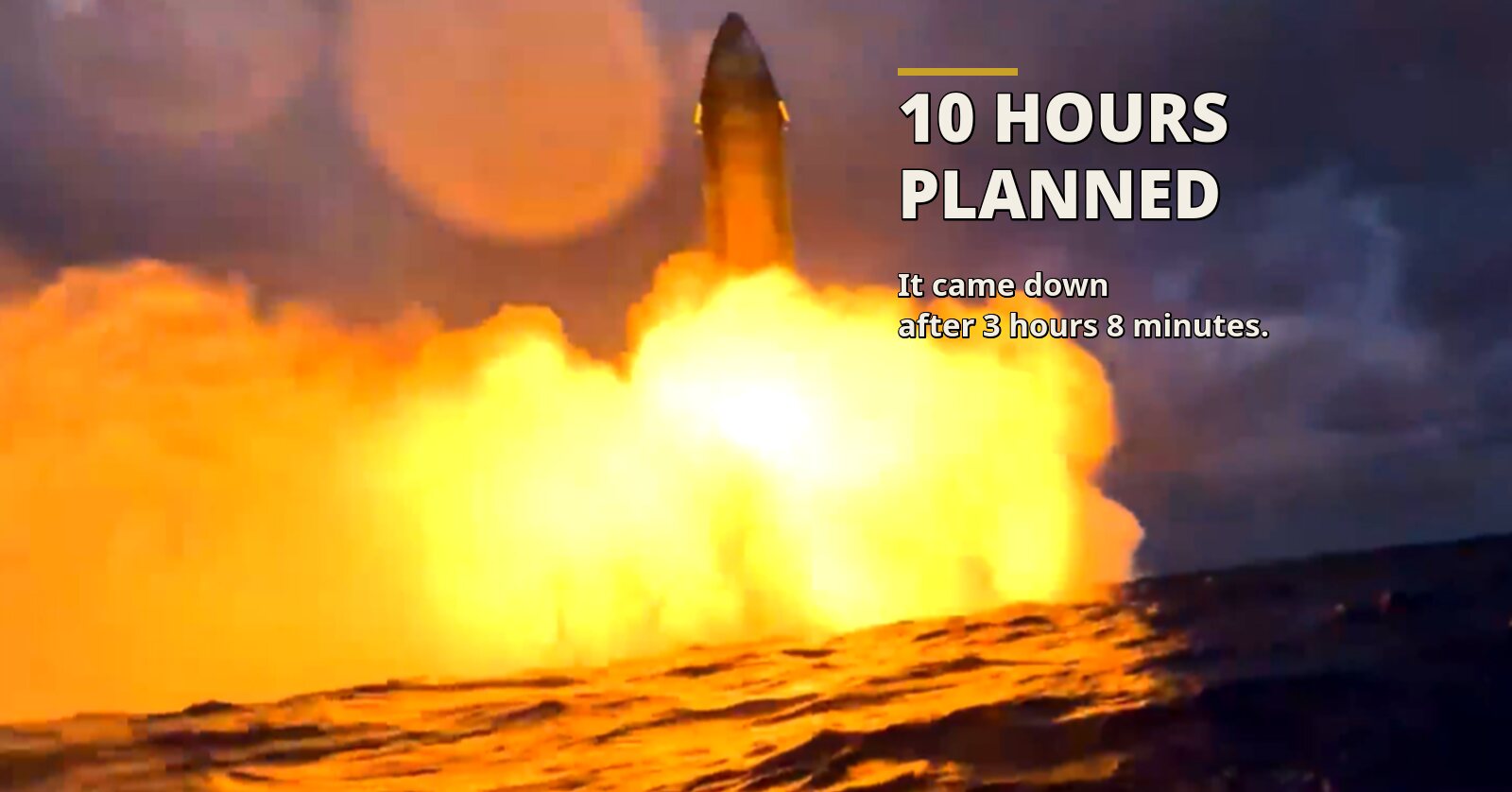
On its first flight to orbit, SpaceX's Starship had engine trouble on both stages and still delivered 26 satellites. The next morning, my own small test showed me the same thing: a plan only holds what you already thought of.
By Peter Plötner. Aerospace engineer and Wayfinder Life Coach. More about Peter →
On September 28, 1 of the 3 vacuum engines on SpaceX's Starship shut down early on the way to orbit. It was Flight 14, the first Starship flight ever meant to stay in orbit.
For a few minutes, SpaceX said the ship would not go there. Then the team checked the ship, changed that call, and put 26 Starlink satellites into orbit. The ship came home about 3 hours after launch, instead of the nearly 10 hours in the plan.
Some things only show up when you fly.
What the plan said
The plan for Flight 14: launch from Starbase in Texas, reach orbit about 25 minutes after liftoff, release 26 Starlink V3 satellites, fly about 6 orbits over nearly 10 hours, then come down in the Pacific west of Chile. 3 of the satellites carried cameras, to photograph the ship's heat shield from the outside.
Why the way down matters most
Most rocket upper stages are thrown away after one flight. When they fall back, they mostly burn up in the atmosphere. Starship is different. It is built to come back, with a heat shield made to survive reentry. That also means it does not burn up on its own. If it came down out of control, a very large steel ship could reach the ground wherever it happened to fall.
So Starship has to be in control on the way down. On every earlier flight, SpaceX kept it just short of orbit. On that kind of arc, the ship falls into a planned stretch of ocean by itself, even if no engine lights again. In orbit it is different: the ship only comes down where you want if its engines fire again at the right moment. That is why SpaceX first had to show, on earlier flights, that a Raptor engine can be restarted in space.
What happened instead
The trouble started with the booster. About 76 seconds after liftoff, 1 of its 33 Raptor engines shut down. For the burn that turns the booster back toward the coast, 26 of the 28 planned engines lit again. For the landing burn, 11 of 13. The booster still came down under control in the Gulf of Mexico, about 7 minutes after launch.
Then, on the climb, 1 of the ship's 3 vacuum engines failed. The burn that would have put the ship into orbit was called off. On the webcast, Dan Huot of SpaceX was explaining the new plan: no orbit, and a landing in the Indian Ocean on the same kind of arc as every flight before.
Then new information came in, and the team looked again. Huot said they checked “all indicators of health on those remaining engines”, and especially “the three center sea-level engines that we need for the orbital insertion burn and for the deorbit burn.”
Those 3 engines were the ones the ship needed to come down in control. They were healthy. So the team said go. About 25 minutes after liftoff, 1 engine fired for 19 seconds, and SpaceX announced: “Starship is orbital.”
The satellites went out over the next 30 minutes, and SpaceX made contact with each one. Then the team dropped the remaining orbits. A little after 2 hours, the engines fired again to bring the ship down, and it splashed into the Pacific north of Hawaii, 3 hours and 8 minutes after launch. 6 seconds later it tipped onto its side, and the fuel left in its tanks burned in a fireball. That shorter landing area was ready before launch, as is normal. The Space Shuttle also had emergency landing sites ready for every launch.
What only flying shows
Look at the engine record of this one flight. On the way up, 1 booster engine shut down. For the turn back, 2 of the planned engines did not light again. For the landing, 2 more. On the ship, 1 of the 3 vacuum engines failed.
SpaceX test-fires its Raptor engines on the ground before they fly. Still, on one flight, engines on both stages had trouble. To me, that says the Raptor engine and its control software still have improvements ahead. And some of those can only be found in flight, where the engine and its avionics meet real vibration, heat, cold and vacuum all at once.
A test stand or a simulation tests what you thought of. A flight tests against the physics of the world.
My own small test, the next morning
The next morning I ran a much smaller test. I sat on a beach at dawn for 45 minutes with a heart strap on, and streamed it live. My plan had one disturbance in it: at sunrise a sudden sound plays, and I measure how fast my heart gets back to where it was. Engineers call that settling time.
The planned sound did nothing I could measure. When I checked it later, its jump was no bigger than the ups and downs my heart makes on its own with every breath.
Other things moved my heart. Just before sunrise, horseflies came, 1 to 2 cm long, the local kind that bites off little pieces of skin. I opened my eyes, chased them away, and killed some of them. A wave reached my foot, so I moved back a meter. My heart went from about 68 beats a minute to between 72 and 75. And the camera recorded only black, so there is no picture of any of it.
My test plan was my simulation. Nothing that moved my heart was in it, and I would not have found any of it by planning longer. I found it by sitting there. The next sit has long trousers and a spot above where the waves reach.
The plan gets you to the test
Planning is not the problem. SpaceX had its second landing area ready, and I had a test plan. But a plan only holds what you already thought of. The rest you learn by testing against the real world, on the launch pad or on the beach.
What did you only learn once you tested it for real?
Frequently asked questions
What happened on Starship Flight 14?
On September 28, 2026, Starship launched from Starbase, Texas. 1 of the booster's 33 engines shut down on the way up, and the booster had trouble relighting some engines for its return. 1 of the ship's 3 vacuum engines failed during the climb. SpaceX first said the ship would not go into orbit, then changed that after checking the engines it needed to come back down. It put 26 Starlink V3 satellites into orbit and splashed down in the Pacific north of Hawaii, where it tipped over and exploded, after about 3 hours, instead of the nearly 10 planned. It was the first time a Starship stayed in orbit and delivered working satellites.
Why did earlier Starships stay just short of orbit?
Starship is built to survive reentry, so it does not burn up if it comes down out of control. On a path just short of orbit, it falls into a planned ocean area by itself. In orbit, its engines must fire again to bring it down where planned. So SpaceX first showed on earlier flights that a Raptor engine can be restarted in space.
Why did SpaceX end the flight early?
The flight was shortened after the engine failure, and the remaining orbits were dropped. In the first reports, SpaceX had not explained the decision in detail. A landing area for a shorter flight had been prepared before launch, which is normal practice. The Space Shuttle had emergency landing sites too.
What was the small test the next morning?
A 45-minute sit at dawn with a heart strap, streamed live, with a planned sudden sound to measure how fast the heart settles. Horseflies and a wave moved the heart more than the planned sound did, and the camera recorded only black.
Can a heart strap measure calm?
No. It measures the heart. It shows how fast the heart comes back after a push, which is one small part of calm.
Two companions: The Rocket Is Not the Point on why Starship's cargo matters more than the rocket, written the week before Flight 14 flew, and How Often Should You Be Wrong? on how many mistakes it takes to learn fast. If you want a first reading on where your own life is running on somebody else's requirements, the Spec Check is 4 questions and takes about a minute.
Related essays
Your space, free
No matter where you start, it walks with you: find what you really want, and be at peace and in joy on the way. Your unfair advantage.
Make my free account