Reusable Rockets, Disposable Joy
By Peter Plötner · · 8 min read
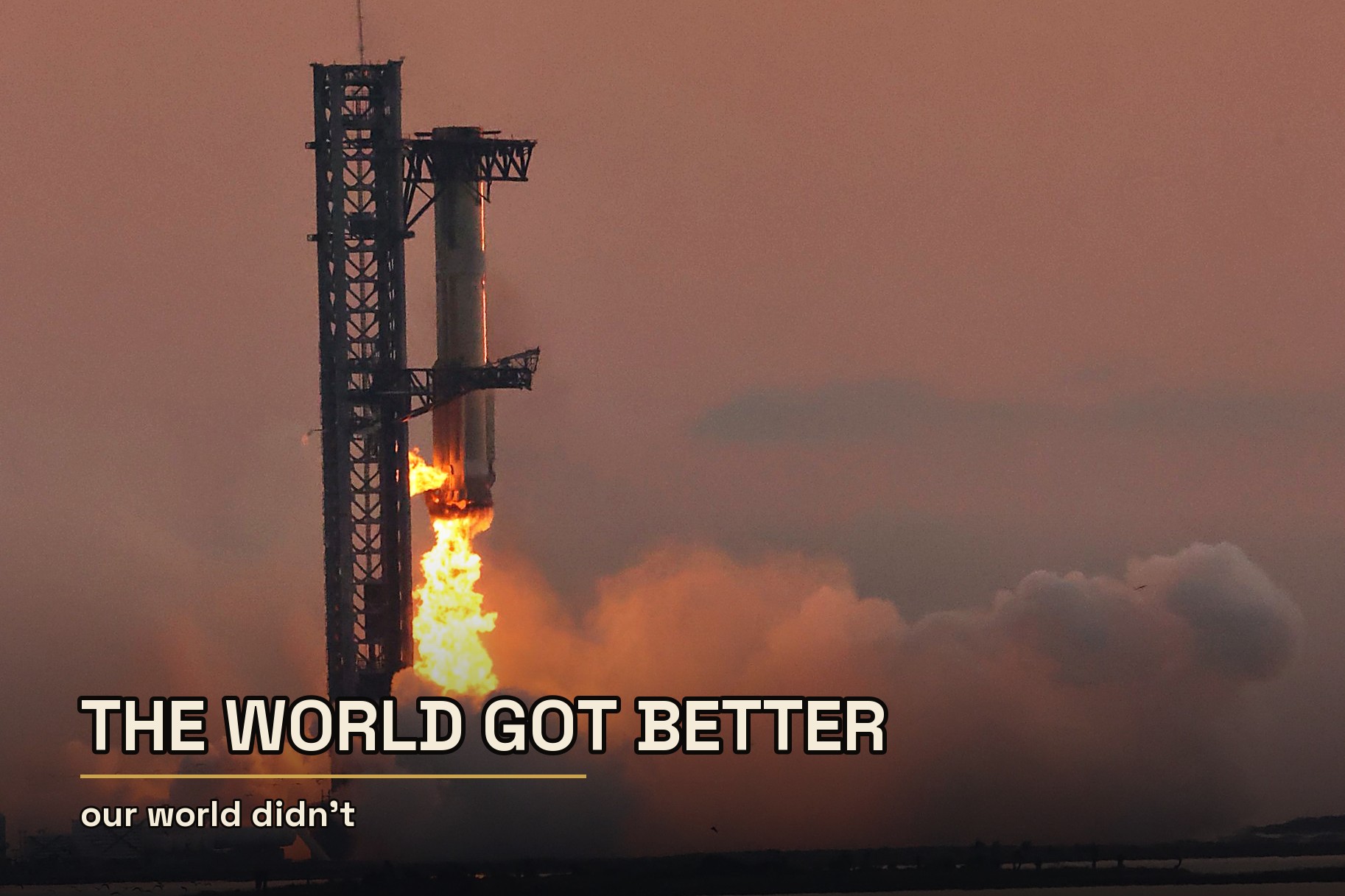
The world got better in almost every way we can measure. The way we actually feel did not get better. A rocket caught out of the sky shows why, and what it would take to change it.
By Peter Plötner. Aerospace engineer and Wayfinder Life Coach. More about Peter →
For most of the space age, we treated a rocket the way most of us still treat the goals we chase to be happy: we use it once, then throw it away. It flew a single time, lifted its cargo, then fell back and burned up or dropped into the ocean, and the next flight began from an empty factory floor.
Landing rockets and flying them again slowly began to change that. Then, in October 2024, it went further than ever: two steel arms reached out and caught a returning booster the size of a twenty story building, softly, out of the air. The moment mattered far past rockets, because most of us are still throwing something far more valuable away, one flight at a time.
That something is our own joy.
Space has run this exact story before, a long plateau and then a restart. It turns out to be a map for the other thing that stalled, our joy and peace. What follows is that one story, told twice: once in rockets, once in us.
The world got better. We just don't believe it.
Start with the good news, because almost nobody does. In 1820, about 84 percent of people on Earth lived in extreme poverty. Today it is under 10 percent. A child born in 1900 could expect to live around 32 years. A child born now can expect around 71. Fewer parents bury a child than at any time in history.
Here is the strange part. When Hans Rosling gave people a simple quiz about this progress, doctors, professors, heads of state, they scored worse than if they had closed their eyes and guessed. He liked to say a chimpanzee picking at random would beat them. We did not just fail to feel the good news. Most of us do not even believe it happened.
None of this means the world is finished, or that the line only ever climbs. Progress stalled in places after 2015, and plenty is still broken. Rosling's own rule was that a thing can be bad and getting better at the same time. Both are true. Hold both.
Our world didn't.
Now the harder news. Over the same stretch that lifted all of those numbers, the one number you would most want to rise sat still. In the rich world, average reported happiness has been roughly flat for as long as we have measured it, about seventy five years, even as real output per person more than tripled.
Be careful with that tripling. It is an average, and averages hide a great deal. The typical worker's real wage has barely moved since the early 1970s. So the honest version is not “we all got three times richer and stayed miserable.” It is quieter and stranger than that. The world filled up with the things that were supposed to make us feel better, and the feeling never arrived.
We fly disposable rockets at our own happiness.
Here is why, and it is the same mistake we made with the rockets. We treat joy as a place you arrive at. Hit the number, close the round, get the title, buy the house. For a moment it works. Then the feeling burns up on reentry, and you are back on the factory floor building the next one. Psychologists have a name for the letdown that follows a reached goal. They call it the arrival fallacy, and the reason arriving never quite satisfies is that most of the good feeling lived in the climb, not the summit.
So we launch again. A bigger goal, a harder target, one more thing to reach. Each one is a single use rocket aimed at our own happiness: expensive, spectacular, and spent in one flight. Wealth turned out to be exactly this kind of rocket. It carried us a long way, into real comfort and safety, which is no small thing. But comfort is low orbit. It was never going to reach the place we actually aimed it, and a bigger version of the same rocket does not change where it can go.
Space made this exact mistake, then started fixing it.
We have run this story before, up in the sky. In 1969 a Saturn V put people on the Moon, one of the hardest things our species has ever done. Then we stopped. Not because we lost the ability. We lost the reason. Apollo was built to win a race, to beat the Soviet Union to the Moon in the middle of the Cold War. Once that race was won, the reason was spent, and the vast machine that made it possible, the factories, the suppliers, the hundreds of thousands of people, was quietly allowed to come apart. For about fifty years we circled in low orbit, busy and going nowhere new.
What restarted it was reuse, and the details matter, because reuse is easy to fake. The Space Shuttle was called reusable too, but refurbishing it between flights cost so much and took so long that it saved almost nothing. Reuse only counts when it is cheap and fast. SpaceX cracked that with the Falcon 9 about a decade ago, landing the booster and flying it again, and again. The next leap is to reuse the whole vehicle, not just the lower stage, and to turn it around in hours. That is what Starship is testing now. The caught booster in the photo above is that leap in one image: not a bigger thing to throw away, but a thing you never throw away at all.
Reusable joy.
Which points straight at the fix for the other plateau. If a one time achievement is a disposable rocket, then the thing worth building is a reusable one. Not a summit you reach and lose, but a source of joy and peace you can relight tomorrow without burning it down.
The research on what keeps that vehicle reusable is surprisingly clear, and it runs three ways. It has to be powered by meaning rather than money, because chasing wealth, status, and image lowers wellbeing even when you win. It has to be held like a horizon, a direction you move toward, not a deadline you pass or fail, because gripping a goal your whole worth hangs on quietly wears you down. And it has to be built from creativity rather than fear, from wanting to make something rather than running from not being enough. That last one is big enough to deserve its own essay, and it will get one.
None of this is the easy road. It is harder to live from your own honest wants than to chase the ones you were handed. But it is a strange kind of harder. It is more demanding out in the world and far lighter on the inside, because you finally stop fighting yourself. That is the trade. You give up the easy borrowed goals for the difficult true ones, and the difficulty out there buys a quiet in here that no achievement ever delivered.
Is there a reason big enough to pay for it?
Space has one more lesson worth stealing. The restart stuck this time because it finally had an engine that pays for itself, and the engine keeps getting stronger. Apollo had a government's will, and when the will was spent, so was Apollo. What holds now is sturdier: Starlink, SpaceX's satellite internet business, earned 11.4 billion dollars in 2025, up about half in a single year, and most of that profit pays to build Starship. Zoom out and the whole commercial space economy passed 686 billion dollars in 2025, growing at double digits and on track for a trillion, a business that barely existed fifteen years ago. That is what a real engine looks like: not a one time budget, but revenue that compounds and funds the next leap on its own.
So the fair question about joy and peace is whether anything could fund a restart like that, or whether it is only a nice idea. The demand already dwarfs space. People spend around 6.8 trillion dollars a year reaching for wellbeing, about ten times the size of the space economy. And the cost of its absence is the clearest measure of the prize: unhappy, disengaged work drains about 8.8 trillion dollars a year from the world economy, close to 9 percent of everything the planet earns. That is not a loss to mourn. That is the size of what is waiting on the other side.
So the money is there. What is missing is a vehicle worth the name. Most of that 6.8 trillion scatters across apps and quick fixes that do not hold. Worse, a much bigger and far better engineered machine is already running the other way. Social media and the advertising that pays for it, a business worth roughly 700 billion dollars a year and ruled by giants like Google and Meta, is built to hold your attention by keeping you scrolling, comparing, and wanting more. It is one of the most profitable inventions in history, and it earns the most precisely when your peace is most broken. Nobody has yet built the opposite at that scale: a machine that makes its money when you need it less.
Which is to say the field is early. Very early.
Where we are, and where I am.
If joy and peace were a rocket program, we would be near the very start of it. As a whole species, we are still at Falcon 1, SpaceX's small first rocket, still trying to reach orbit at all. The flat happiness line is the proof: we have not yet shown that a good life can be delivered reliably, at scale, to most people. One person at a time, it is further along. Someone who does the real work can reach something that lasts and relight it again and again, which is to say that for the committed individual the vehicle already works. Call that the Falcon 9: reliable, reusable, proven over hundreds of flights. What nobody has cracked is making it cheap and simple enough to reach everyone, not only the few with the time and money to do the work. That gap, works for the few versus works for everyone, is the whole task. I call it flow for everyone: start where it is hard and costly, and keep building until it reaches an ordinary life.
My own piece of it is earlier still. A young coaching practice, a handful of people, a great deal left to learn. SpaceX's Falcon 1 failed three times before it reached orbit on the fourth try, on the last of the money left in the company. I do not know how many failures sit between me and orbit, only that there will be plenty, and I have made my peace with that.
If you want the smallest version of this for yourself, it is not a five year plan. It is one honest question about what you would move toward if you stopped chasing what you were handed. What would you build, if joy were something you got to make, instead of something you were still waiting to arrive?
Frequently asked questions
Why hasn't getting richer made people happier?
In the rich world, average reported happiness has stayed roughly flat for about seventy five years, even as real output per person more than tripled. That figure is an average, though; much of the growth went to the top, so the typical person never saw a threefold gain to begin with. Part of the reason the feeling stayed flat is the arrival fallacy: most of the good feeling in a goal lives in the pursuit, so reaching it brings a brief lift and then a return to baseline. Chasing wealth and status also does less for wellbeing than meaning and connection, even when you succeed.
What is the arrival fallacy?
It is the letdown that follows reaching a goal you were sure would make you happy. The win feels good briefly, then fades, because much of the joy was in the climb rather than the summit. It is why one achievement leads straight to needing the next one.
Is the world actually getting better?
By most objective measures, yes, and dramatically. Extreme poverty fell from about 84 percent of people in 1820 to under 10 percent today, and global life expectancy roughly doubled since 1900. Progress is uneven and has stalled in places since 2015, so the honest summary is that the world can be both bad and getting better at the same time. Notably, most people, including experts, badly underestimate this progress.
What does a caught rocket have to do with happiness?
For most of the space age, rockets were thrown away after a single flight. Reuse changed that: SpaceX began landing and reflying the Falcon 9 booster about a decade ago, and catching the whole vehicle, as Starship is now testing, is the next leap. Most of us treat happiness the disposable way, as a one time achievement we reach and then lose. The essay argues the real fix, in rockets and in life, is a reusable source you can relight, not a bigger thing to burn once.
What does “flow for everyone” mean?
It is the idea that a durable sense of joy and peace, which today mostly reaches the few with the time and resources to do the inner work, could over time be made simpler, cheaper, and available to ordinary lives. Like reusable rockets, it starts hard and expensive and aims to become something close to universal.
If this one landed: Fail Faster to Get There Sooner is the piece that first pointed at this vision, and The Best Part Is No Part is the same move, subtraction, at the scale of one life. The Spec Check is one place to start asking the question above. And if you know someone who has everything they were supposed to want and cannot say why it still is not enough, send them this.
Related essays
Your space, free
No matter where you start, it walks with you: find what you really want, and be at peace and in joy on the way. Your unfair advantage.
Make my free account