Fail Faster to Get There Sooner
By Peter Plötner · · 7 min read
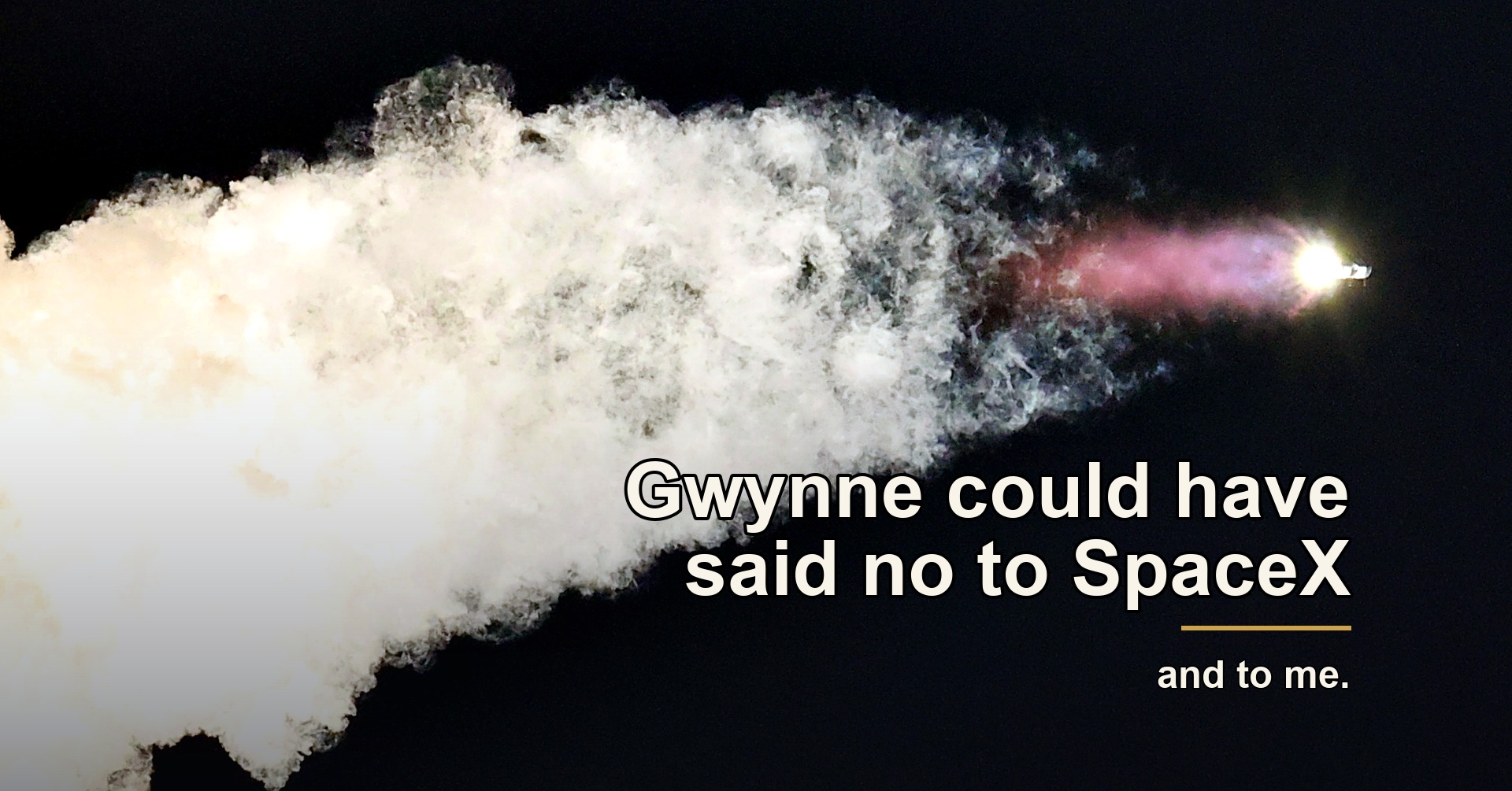
The surest way to reach something almost impossible is to fail at it as fast, as cheaply, and as often as you can, fixing every step on the way.
By Peter Plötner. Aerospace engineer and Wayfinder Life Coach. More about Peter →
One second before liftoff, the most powerful rocket ever built refused to fly.
It was Starship Flight 13. Four of the booster's thirty-three engines were not starting cleanly, so the rocket's own software shut the whole launch down at T minus zero. No fireball. No lost vehicle. Just a quiet stop on the pad, engines off, everyone safe. Then SpaceX pulled the two worst engines, replaced them, and rolled back out to try again eight days later.
The president of SpaceX, Gwynne Shotwell, has seen far worse than a stopped launch. She joined the company before it had put up a single rocket, when every sensible voice would have told her to say no. She said yes, watched its first three rockets fail in a row and nearly run out of money, and stayed. Years later, from a cold inbox, she answered an email from me in about eleven hours. Twice, at least, she could have said no. She did not, and that is the whole story.
An email I sent at 5:37 in the morning
In August 2013 I was volunteering in Honduras, a few weeks from starting a PhD in Tokyo on steering tiny robots through blood vessels with magnets. I had just watched a keynote of hers on YouTube, where she mentioned in passing that she had once started a PhD and walked away from it.
So at 5:37 one morning I wrote her a short email. I said what I was about to study and asked one question: what matters most in a PhD, and what should I be sure to learn while I had the chance. A stranger, a cold inbox, the president of the company trying to put people on Mars.
She answered in about eleven hours.
Was it luck? Partly, of course. But luck is not a fixed thing you either get or you do not. You tilt it. You take more shots, and you make each one harder to ignore: short, specific, tied to something the person actually said. My email was not brilliant. It was just sent, and most people never send it.
If she had said no, I would have been out ten minutes and a little pride, and I would have written the next one that same afternoon. Most of what I try goes nowhere, which is exactly how you find the few things that go somewhere.
Shotwell ran the same math, with more zeros. Joining a rocket company that had never launched was a real risk, but a bounded one. If SpaceX failed, she could find another good job. The risk she could not stomach was the other one: saying no to play it safe, then watching SpaceX work from the outside, knowing she could have been part of it. A job you lose, you can replace. A yes you never said, you cannot.
Build the thing. Test the thing.
Her advice, in my own words, was simple. The most important part of anyone's background is the hands-on work. Do not hide in theory. Build your ideas, test them against the real world, and do not be afraid to fail. One line of hers I keep is, “You don't learn anything from success.”
I took it literally. My diploma thesis had been a computer model of the air inside the Space Station: how carbon dioxide builds up in the cabin, and how the life-support system scrubs it back out. All math, nothing you could touch. For the PhD I did the opposite. I built a real test stand: two industrial robots, electromagnets I designed myself, a rig whose only job was to let the real world argue with my simulation. The math was where I felt safe. The stand was where I could be wrong, fast.
First you need somewhere to fail toward
Failing fast only means something if it points at a vision big enough to be worth it. Shotwell's is not shy. “We are not going to lose sight of our Mars vision,” she says. A goal that big gives all the small failures a direction to fall in, and it makes room: thousands of engineers each get to chase the one piece of Mars that is theirs.
Mine, for a long time, was to fly to space. It still pulls at me. But there is a bigger one now. In the rich world our wealth has multiplied since the 1960s, and by most measures our reported happiness has barely moved. Something leveled off. It reminds me of space itself, which went quiet for decades after the moon landing, until SpaceX decided the quiet was not permanent. I think joy and peace are due for the same kind of restart.
The math of almost impossible
Here is the part most people get backwards. When something is very unlikely, the answer is not to wait until you are sure. It is to take more shots, and to make each one smarter than the last. Every real attempt does two things. It gives you a small chance of working. And, if you set it up right, it hands you a pile of information about what went wrong. Fix that, and the next attempt is not a fresh roll of the dice. It is a better one. Do that enough times and the odds quietly bend. The almost-impossible starts to look merely hard.
If you are building a company, you already live some version of this: ship the thing, watch it break, fix what broke, ship again. SpaceX just does it louder, while the rocket is still being invented. The company that nearly died after those first three Falcon 1 failures is the same one now aiming at Mars. Elon Musk put it plainly: “If things are not failing, you are not innovating enough.”
But blowing things up is only half of it, and the loud half. The quiet half is catching the small stuff before it can grow into a real failure. That is what Flight 13's abort was: the rocket found two weak engines, stopped itself on the ground, and the team swapped them out. A problem caught on the pad never becomes a fireball in the sky. That patient half is what earns you the right to take the risky shots at all, and it is why the next try comes in days, not years.
So how did the second try go?
Eight days after the stopped launch, and one more wave-off for weather, Flight 13 flew.
Most of it worked. The rocket climbed. It let go of twenty real Starlink V3 satellites, the first working ones it has carried instead of dummy weights. Then the upper stage came back down through the fire of reentry, lit its engines near the water, and set itself down so gently that the team called it the softest landing they had ever gotten.
One piece missed. On its way home, the booster had to relight thirteen engines to slow itself for landing. Not all of them lit. It came in hot, faster than anyone wanted, and hit the water harder than planned. Still under control, still on target, but not the soft landing they were after.
Now look at the shape of that list. The frightening parts worked. The part that broke, broke over empty water, with nobody aboard, on a flight whose whole job was to find out what breaks. It cost them a booster that was going in the water either way, and it bought them the exact reason those engines did not all light. Yesterday that was an unknown. Today it is a design fix.
That is what a good failure looks like. Nobody would call a booster cheap. But rockets cost what they cost, and the ones that come back with answers are the cheapest kind you can buy.
The failing is a phase, not a personality
And here is the part people miss: the failing is a phase, not a personality. You fail fast while the thing is still young. Once it grows up, the same discipline flips into its opposite. Falcon 9, the rocket that came after those early explosions, has flown hundreds of missions in a row without a failure and carries astronauts to orbit. It is one of the safest rockets ever built. The failing was never the goal. It was the fastest way to get there.
A cold email is the same move, shrunk to pocket size. It costs almost nothing. It usually goes nowhere. But it can only work if you send it, and every one you send teaches you how to send a sharper next one. The easy half of all this is the line everyone repeats: failing is fine. The harder half is that not trying is the only failure that is permanent.
Where to point this on Monday
So here is the whole thing, shrunk to your size. Pick a goal big enough to scare you a little. Find the smallest real step toward it, the one that can actually fail this week: a cold email, a rough prototype, a hard conversation, a draft you show one person. Take it. When it does not work, and often it will not, keep what you learned, fix one thing, and take the next step. The people who reach the almost-impossible are usually just the ones who kept sending the email.
What is the shortest, cheapest version of your big shot, the one you could actually send or build this week, knowing full well it will probably not work the first time?
Frequently asked questions
What did the email to Gwynne Shotwell say?
It was short and specific. In 2013, before starting a PhD, I asked the president of SpaceX one question: what matters most in a PhD, and what should I be sure to learn. She replied in about eleven hours, with advice to focus on hands-on building and testing rather than theory alone.
What is SpaceX's “fail fast” approach?
Instead of trying to design a perfect rocket on paper, SpaceX builds real hardware and flies it, accepting that some flights will fail, because a real failure hands you data no success can. It is a development strategy, not a way of operating forever: once a design matures, the same discipline produces extreme reliability. Falcon 9, which came after those early explosions, now flies hundreds of times in a row without a failure.
What happened with Starship Flight 13?
It took three tries. The July 16, 2026 attempt shut itself down at T minus zero because four of the booster's engines did not reach safe start conditions. SpaceX replaced two engines, weather pushed the next attempt, and the rocket flew on July 24. It released twenty real Starlink V3 satellites, and the upper stage came back through reentry to the softest water landing it has managed yet. The booster did not relight all thirteen of its engines for the landing burn, so it came down harder than planned, though still under control. Most of the test objectives were met, with one clear thing to fix.
Does “fail faster” mean being reckless?
No. The point is the opposite. An abort like Flight 13's is not even a failure, it is the careful work that stops a small problem before it becomes a real one. When a real failure does come, you make sure it cannot take down the whole company, and that it teaches you as much as possible. You point the whole effort at a vision worth the risk. Careful on the ground, brave in the air, not reckless.
How does this apply if I'm not building rockets?
Pick a goal big enough to matter. Take the smallest real step you can toward it this week, one that can actually fail. Learn from what happens, fix it, and take the next step. A cold email, a first prototype, a hard conversation: each is a cheap shot that teaches you how to take a better one.
Two companion pieces, if this one landed: The Safest Rocket Never Launches is about the failure hidden inside never trying, and You Don't Prevent the Failure. You Make It Safe. is about designing your failures so they land soft. If you are sitting on your own version of the email you have not sent, the Spec Check is a decent place to find the first small thing you could risk this week. And send this to the one person you know who is sitting on an email they will not let themselves send.
Related essays
Your space, free
No matter where you start, it walks with you: find what you really want, and be at peace and in joy on the way. Your unfair advantage.
Make my free account