Most Things Aren't Broken. They're Out of Fuel.
By Peter Plötner · · 6 min read
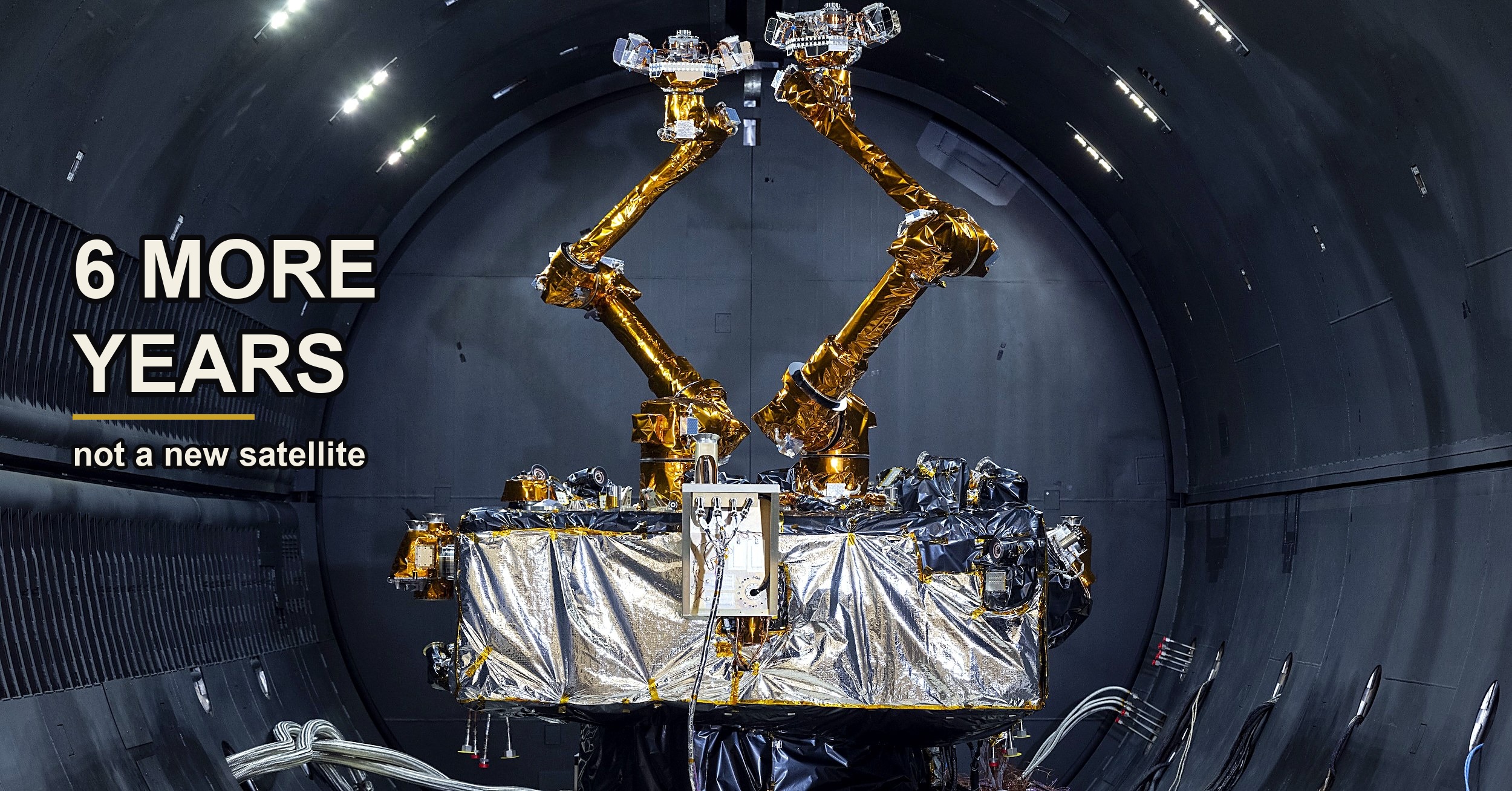
A robot with two arms just launched to save old satellites that are running low on fuel. Not broken. Just running low. We almost never do that with the things we build, and it is worth asking why.
By Peter Plötner. Aerospace engineer and Wayfinder Life Coach. More about Peter →
A spacecraft with two robotic arms just launched to do something we almost never bother to do. It is going to hunt for old satellites that are nearly out of fuel, still working fine, just running low, and give them more life instead of a push out to the graveyard orbit.
It is called the Mission Robotic Vehicle, built by Northrop Grumman, and it went up on a Falcon 9 on July 21. For the next year it will coast out to the ring of satellites about 22,000 miles (35,000 km) above us. When it arrives, it will use those two arms to bolt a small propulsion pod, basically a jetpack, onto satellites that are nearly spent. The pod does the steering and the thrusting the tired satellite can no longer do for itself. That buys 6 more years, at least. The first customers are two telecom companies, Optus in Australia and SES in Luxembourg. One robot mechanic, carrying 3 of these jetpacks, moving from one patient to the next.
It already worked once
This is not a science-fair idea. A simpler version already pulled it off. In February 2020, a Northrop Grumman craft called MEV-1 chased down Intelsat 901, a communications satellite so low on fuel that its owners had parked it and were getting ready to retire it. It caught the satellite 22,000 miles up and docked with it, the first time two commercial satellites had ever done that. Then MEV-1 took over the flying and pushed 901 back into its working slot. That satellite went back to work for 5 more years. A second craft did the same for another Intelsat satellite in 2021. The thing everyone had written off was not broken. It was just out of fuel.
We have done the hands-on version for years. Five separate times, astronauts flew up to the aging Hubble telescope and repaired it by hand, which is the only reason a telescope launched in 1990 is still sending back pictures today. What is new is doing that work with robots, cheaply, on satellites nobody is ever going to send a person to. The two gold arms in the photo above are the new hands, built with the Naval Research Lab and NASA.
We call it dead when it is only out of fuel
That is the whole idea, and it is easy to miss. We treat “old” and “done” as the same word. They are not. So much of what we throw away is not broken. It still works. It has just run low on something, fuel, attention, upkeep, and we decide that is the end of it.
You have watched this happen. I have watched it a lot. Something gets built with real care, launched with a lot of noise, and then left completely alone. Nobody tends it. Within a year or two it quietly stops working, not because it failed, but because no one kept it running. We are very good at the launch. We are strangely bad at everything that comes after.
There is a reason for that, and it is not that people are lazy. Building is visible. Launching gets the photo, the money, the applause. Maintenance is quiet by nature. Nobody claps for the person who keeps the old thing alive. So we pour our energy into the new and let the working thing drift, because starting fresh feels like progress and keeping something going feels like standing still. The Mission Robotic Vehicle is an expensive bet on the opposite idea. That the tired, overlooked thing that still works is worth flying a full year across space to save.
The thing you built might just be low on fuel
If you build things, you know this reflex from the inside. The product slows down. The team loses its edge. The routine that used to carry you stops delivering. And the first thing you reach for is a teardown. Rebuild it. Start the new version from scratch. Replace the whole thing. Sometimes that is right. But a lot of the time what you built is not obsolete. It is out of fuel. It still does the job it was made for. It needs propulsion again, a repair, some real attention, a jetpack, not a funeral and a fresh launch.
Here is the hard part, the part the robot cannot do for you. Not everything deserves a jetpack. Some satellites really are obsolete, built for a job the world no longer needs, and the honest move is to let them go. Cutting what no longer serves you is its own skill, and I have written about it before. This is the other side of the same coin. The question underneath both is one and the same. Is this still doing a job you actually need. If yes, it does not need replacing. It needs fuel. And sometimes the boldest move is not a new idea at all, it is to double down on the thing that already works, to feed it more instead of running off after the next new one. If no, no amount of fuel will save it, and keeping it on life support is its own kind of waste. Refuel what still fits. Let go of what does not. The real mistake is doing neither, and letting the tank run dry by accident.
Is that bad, or just how things go?
So is it a bad thing, this habit of building and abandoning. I go back and forth on it. Maybe it is just the nature of things, the old making room for the new. Maybe letting some things die is part of how we make better ones. There is truth in that. Not everything should be kept alive.
But I think we let far more go than we mean to, and almost none of it on purpose. It dies from neglect, not from a decision. And the fix might be simpler than a cleverer machine. It might be treating the things we make as relationships instead of deliveries. You do not launch a satellite and forget it anymore. You stay with it. You watch it. You give it more when it runs low. Maybe the things we build, and the people around us, are owed a little of that same shift, from launch and abandon to something closer to care over time.
The Mission Robotic Vehicle will spend a full year flying toward something almost everyone else was ready to give up on. That is a strange and hopeful thing to send into space. It is also a good question to bring back down to the ground.
Frequently asked questions
What is Northrop Grumman's Mission Robotic Vehicle?
A satellite-servicing spacecraft with two robotic arms, launched on July 21, 2026. Over about a year it travels out to geostationary orbit, then installs small propulsion units called Mission Extension Pods onto aging satellites, giving each at least 6 more years of life. It can also inspect, repair, and move satellites, and one vehicle can service several by leaving a pod behind and flying on to the next.
Why not just launch a new satellite instead?
A new geostationary satellite plus its launch can cost hundreds of millions of dollars. Many old satellites are not broken, they are only out of fuel. Flying a robot up to add propulsion is far cheaper than replacing a satellite that still does its job.
Has in-orbit life extension actually worked before?
Yes. In 2020 Northrop Grumman's MEV-1 docked with Intelsat 901, a satellite low on fuel, and extended its service by 5 years. A second vehicle did the same for another Intelsat satellite in 2021. Astronauts also serviced the Hubble Space Telescope by hand 5 times, which is why a telescope launched in 1990 still works today. The Mission Robotic Vehicle makes the idea cheaper and repeatable with robots.
How does this apply to my work or my life?
When something you built slows down, the reflex is to rebuild it from scratch. Often it is not obsolete, only out of fuel: it still meets the need and just wants attention, a repair, or new momentum. The skill is telling the two apart. Refuel what still fits the job. Replace only what the world has truly moved past.
Isn't it sometimes better to let old things go?
Yes. Not everything deserves saving. Some things are genuinely obsolete, and keeping them alive drains effort better spent elsewhere. The point is to choose on purpose, by asking whether the thing still does a job you need, instead of letting it die quietly from neglect.
This is a companion to Delete Where It Hurts, on knowing which parts to cut. Cutting and keeping turn out to be the same skill seen from two sides. If you want a quiet way to see which parts of your life still fit and which have simply run low, the Spec Check is 4 questions and takes about a minute.
So here is the one to sit with. What in your life are you about to rebuild from scratch that might only be low on fuel? And what would it take to refuel it instead of replacing it?
Related essays
Your space, free
No matter where you start, it walks with you: find what you really want, and be at peace and in joy on the way. Your unfair advantage.
Make my free account