Nothing Went Wrong for Ten Years
By Peter Plötner · · 9 min read
For founders and senior leaders: the failure that gets you is almost never the dramatic one. It is the small drift that went fine for years, until the day it did not.
By Peter Plötner. Aerospace engineer and Wayfinder Life Coach. More about Peter →
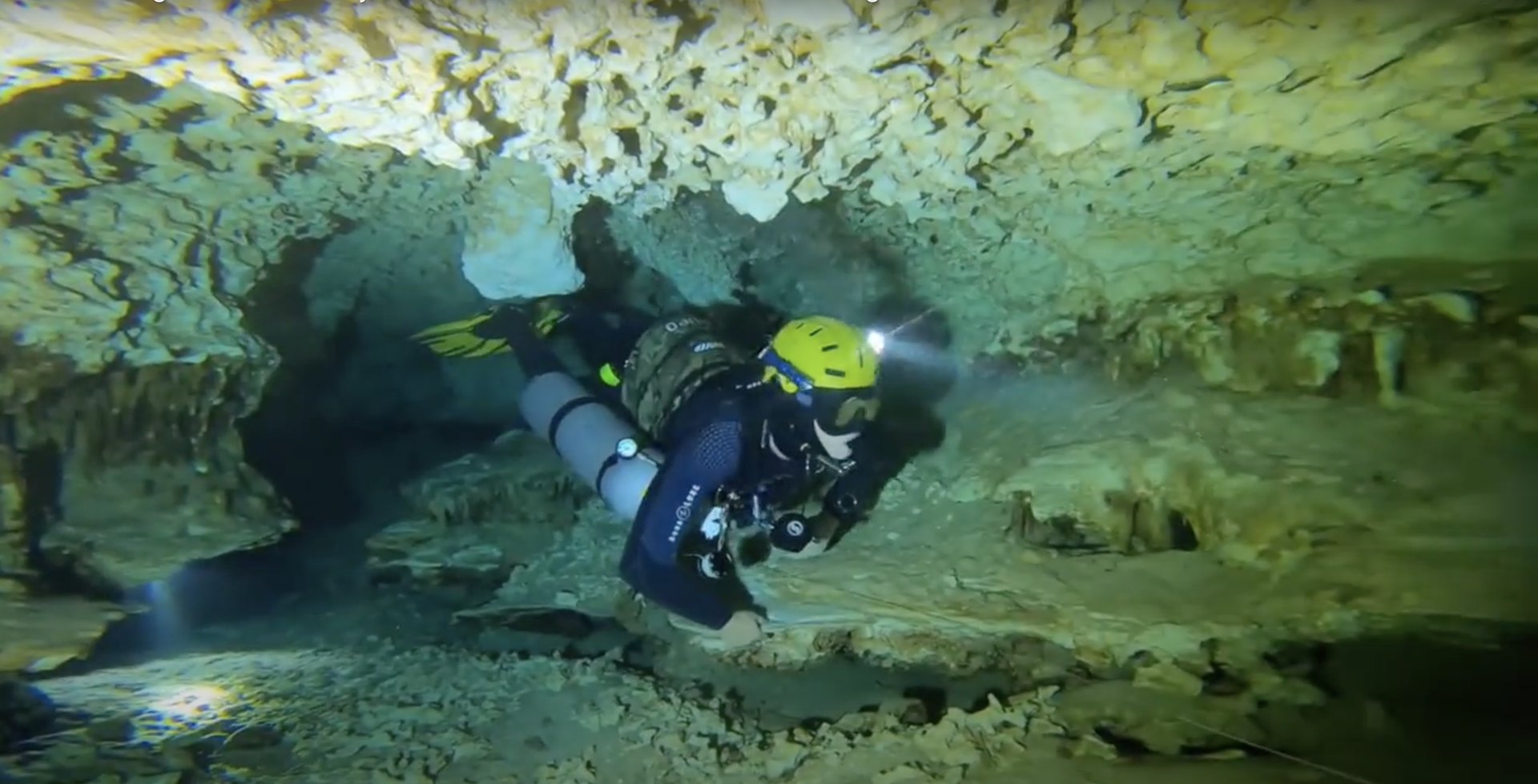
A few years ago, ten minutes from the exit of a cave, the air I was breathing slowly stopped.
I was fine. I want to say that first. I had two good tanks of my own, I switched to one of them, and I swam out. But in a real emergency, that exact moment, ten minutes of hard swimming from open water with no air coming through the regulator, is the moment a diver dies. And I had chosen to be there, because I had lost an argument with three more experienced divers and then decided to accept the risk anyway.
Here is the disagreement. In cave diving there is a safety rule called the rule of thirds. You use one third of your air going in, one third coming out, and you keep one third in reserve. With balanced tanks it works cleanly.
But that day our tanks were not balanced, for any of us. One held a lot, the other much less. The rule of thirds, applied to the combined total, said we could go a certain distance in. What I kept arguing, and I argued it hard before we got in the water, was a different number. If you have to plan around the smaller tank, because the smaller tank alone has to get you out if the fuller one fails or is lost, then the safe distance was much shorter than the rule of thirds suggested.
I did not win the argument. The three of them, all more experienced than me, wanted to follow the rule as written. So I made my own call. I judged that even in a near-catastrophic failure we would probably not lose more than two full tanks, and that between the four of us the remaining tanks gave us enough collective margin to get everyone out. On that basis, I accepted the increased risk and did the dive. That was my decision, not theirs, and I want to be honest that I chose to take a risk I had just argued against.
On the way out, breathing from the tank in question while buddy breathing, the air slowly ran dry. Exactly where my argument had said it would. Far from the exit, in the dark. It was not dangerous in that moment, because I had my own two good tanks and switched to them. But there it was, the precise point where, without that margin, I would have died.
Nothing went wrong, only because the collective margin I had counted on was actually there. But I had just felt, with my own lungs, the precise point that would have killed me if the margin had not held. I had been right in the argument, gone ahead anyway, and gotten away with it. That combination is exactly how people learn the wrong lesson. The dive worked, so the shortcut looks safe.
The rule I made after that dive
I made myself a promise after that dive. On anything that is mine to carry, my safety, my margins, my life, I would trust my own assessment and take responsibility, even when I am the student and the person I disagree with is the teacher.
But only in one direction, and this is the part that matters. I will override more experience only toward more caution, never toward more risk. If a teacher says a thing is safe and something in me says it is not, I listen to the quiet no. If a teacher says stop and I want to push further, I stop. My own judgment gets a veto toward safety, never toward danger. That day I had done the exact opposite. I let myself be talked past my own caution into more risk, and the cave showed me precisely where that ends. Surviving it was the warning, not the reassurance.
I am writing this for the people who build things. Founders, senior engineers, the technical leaders who take real risks for a living. You are good at risk. You take it on purpose, calculated, eyes open, because the upside is worth it. Sometimes it costs you, and you knew it might. That is not the danger I mean. The danger is the other kind of risk, the kind that creeps in one small step at a time, or the kind someone talks you into against your own quiet judgment. Not the risk you chose and priced, but the risk you never actually agreed to. That is the same thing that nearly killed me in that cave, and it almost never announces itself.
The dive that kills you went fine last time
Here is the thing that actually kills experienced divers, and it is not usually one big dramatic mistake. It is something quieter, and it has a name.
Engineers know the name, because it came out of the Challenger investigation. The sociologist Diane Vaughan called it the normalization of deviance. The space shuttle's O-rings had shown damage on earlier flights, damage they were never designed to take. But nothing catastrophic had happened, so that damage slowly got accepted as normal. Each flight that survived made the next deviation easier to wave through. Until one cold morning the deviation that had been fine a dozen times was not fine, and seven people died seventy-three seconds after launch.
That is the pattern. You skip one small step in the process, and nothing goes wrong. So next time you skip it again, and maybe a second step too. Nothing goes wrong. For a year. For ten years. For hundreds of dives. Every successful shortcut quietly teaches you that the shortcut is safe. And then one day the conditions line up, the small deviations compound, and the thing that went fine a hundred times kills you.
It is not only divers and rockets. It is the metric you quietly stopped checking because it was always green. The cofounder conversation you stopped having because it was always fine. The quality step the team dropped while scaling because nothing broke. The standard you let slip by one degree a year for ten years. Each step was reasonable. Nothing went wrong. That is exactly what makes it dangerous.
The dive that kills you is almost always the one that looks exactly like the last hundred that were fine.
This is why cave divers train the way we do. We practice losing our air, losing our light, losing the guideline that leads out, losing the markers at the junctions, in the dark, on purpose, over and over. And the real discipline is not the drills. It is refusing to let the process erode. You run the full protocol even on a short dive. Even with experienced people. Even when it feels like overkill. Because the whole danger is that skipping it will feel fine, right up until it does not.
There is a saying in dive training about this. People taught to call out a code word during practice rescues, so nobody thinks it is a real emergency, will sometimes call out that same word during an actual emergency, out of pure habit. Whatever you let yourself practice is what you will do when it counts. So you practice the thing you actually want to happen.
Two ways to be underwater
There are two completely different ways to be in the water, and they map onto two completely different ways to be in a life.
The first is the vacation diver on a guided tour. The guide handles the navigation. The guide watches everyone's air. The guide picks the route, sets the pace, runs the checks. The diver just follows the fins in front of them and looks at the fish. And there is nothing wrong with that, except this: that diver is not actually responsible for their own dive. If the guide is good, they are fine. If anything goes wrong outside the guide's attention, they often do not even notice it happening. I have watched these divers lose their group, forget to check their air, and drift into coral, with no idea any of it was happening.
The second is the cave diver. In a cave you might be forty minutes from the nearest breath of open air. So every cave diver has to be fully capable of doing everything alone. You carry everything twice, two tanks, two lights, two cutting tools, sometimes two masks. Your buddy is not your navigator and not your air supply and not the person who keeps you safe. Your buddy is a backup brain, nothing more. You do not rely on them to run your dive. If you get separated, you do not search and panic. You each get yourself out, and you meet outside.
Most people are living the guided-tour version of their life. The route was planned by someone else, or by everyone else, which usually turns out to be a handful of specific people whose expectations you absorbed without noticing. The pace is set for you. You follow the fins in front of you. And as long as the guide is good, you are fine. The problem is that it is not your dive. You are not noticing your own life. You are following it.
This catches builders in a particular way. You can found a company and still be on a guided tour, following the route a board, a market, or an old version of yourself laid out, optimizing hard inside a plan you never actually chose. You can run a senior team and be flawlessly executing a career someone handed you a decade ago. High performance hides it well. You can be the strongest diver in the group and still not be the one deciding where the dive goes.
The shift is to take responsibility for the dive. Check your own requirements. Remove the gear that does not serve you. Plan your own route. Still dive with people you love, still have your buddies, but do not outsource the safety of your one life to them. A good buddy is a backup brain. They are not supposed to be the reason your life works.
The deviance I did not notice
I want to be honest that the most dangerous normalization in my life had nothing to do with a cave.
Over fifteen or twenty years, without noticing, I slowly normalized feeling less. A little less open. A little more guarded. Laughing a bit less. Same mechanism as a skipped safety check, just pointed at my own inner life, which is what makes it such an interesting failure to catch. Each small step seemed completely reasonable in the moment, the way skipping one safety check seems reasonable. And nothing went wrong. I functioned. I achieved things. By every external measure the dive was going fine.
Then one day I looked up and saw how narrow the band had gotten, and I could not point to when it happened, because it never happened all at once. That is the whole trick of the pattern, and seeing it was a strange relief. It happened the way every dangerous normalization happens. One unnoticed step at a time, over years, with nothing visibly going wrong to warn me.
The inner work I do now, the same work I do with the people I coach, is at its core just this. Learning to notice again. To feel the full range, the good and the difficult both, instead of the narrowed band I had drifted into without consent. I laugh more now than I did ten years ago. I also feel the hard things more sharply. And I have come to believe those two are the same thing, not a trade. You need whatever you call difficult in order to notice whatever you call good. Numb the bottom of the range and the top quietly goes with it. That is what I had done without realizing. I had turned down the hard feelings, and the bright ones faded by the same amount, and the dive looked fine the whole time.
The opposite of not noticing is not comfort. It is being awake to all of it.
That is the failure mode underneath all the others. Not bad luck. Not one big mistake. Just the slow, silent, compounding drift of things going fine while something quietly erodes, in a cave, in a machine, or in a person, until someone finally notices. The entire skill is to be the one who notices early.
Try this week
Pick one area of your life or your work that has been going fine. Not in crisis, not dramatic, just quietly fine. That is exactly where normalization hides. The green metric. The smooth relationship. The part of the business nobody worries about.
Then ask the one question that surfaces it: what have I slowly stopped doing, or slowly started tolerating, that I would have noticed immediately if it had happened all at once? The skipped check. The conversation you no longer have. The standard that slipped one degree a year. The feeling you have learned not to feel.
You are not looking for a disaster. You are looking for the quiet erosion before there is one. That is the whole skill: not surviving the big failure, but noticing the small drift early enough that there never is one.
So I will ask you directly. In the part of your life that has been going fine for years, what is the one deviation you have quietly normalized? And what would it cost you if you kept not noticing it?
Frequently asked questions
What is the normalization of deviance?
It is a term the sociologist Diane Vaughan coined studying the Challenger disaster. A deviation from the safe process happens, nothing bad results, so the deviation slowly gets accepted as normal. Each time it survives, the next shortcut is easier to wave through. The danger is not one dramatic mistake; it is the small drift that goes fine for years, until the conditions line up and the thing that was fine a hundred times suddenly is not.
How do I spot it in my own work before it bites?
Look where things have been quietly fine, not where there is a crisis. The metric you stopped checking because it was always green. The conversation you stopped having because it was always fine. Then ask: what have I slowly stopped doing, or started tolerating, that I would have noticed at once if it had happened all at once? The whole skill is noticing the erosion early, while it is still small.
Aren't founders supposed to take risks?
Yes, and that is a different thing. The risk you choose on purpose, calculated, eyes open, because the upside is worth it, is good risk, even when it costs you. The dangerous kind is the risk you never actually agreed to: the one that creeps in one small step at a time, or the one someone talks you past your own judgment into. Not the risk you priced, but the one you absorbed without noticing.
When should I trust my own judgment over a more experienced person?
My rule, learned the hard way: override more experience only toward more caution, never toward more risk. If a teacher says a thing is safe and something in you says it is not, listen to the quiet no. If they say stop and you want to push further, stop. Your own judgment gets a veto toward safety. The dive that nearly ended me was the time I let myself be talked the other way, past my own caution into more risk.
What does “living the guided-tour version of your life” mean?
On a guided dive, someone else picks the route, sets the pace, and watches your air; you just follow the fins ahead. Plenty of lives run the same way, including successful ones. You can found a company or lead a senior team and still be flawlessly executing a plan you never chose. The shift is to take responsibility for the dive: check your own requirements, plan your own route, and keep your buddies as a backup brain, not as the reason your life works.
Taking responsibility for the dive starts with checking your own requirements, which is the subject of Stop Optimizing Your Life. Start Specifying It. And learning to notice again, to feel the full range instead of the narrowed band you drifted into, is the work in Tight Chest. Less Tight Chest. If you want a place to start, the Spec Check is four questions that take about sixty seconds, a quick read on which parts of your life are quietly eroding while everything looks fine.
Related essays
Your space, free
No matter where you start, it walks with you: find what you really want, and be at peace and in joy on the way. Your unfair advantage.
Make my free account