How Often Should You Be Wrong?
By Peter Plötner · · 7 min read
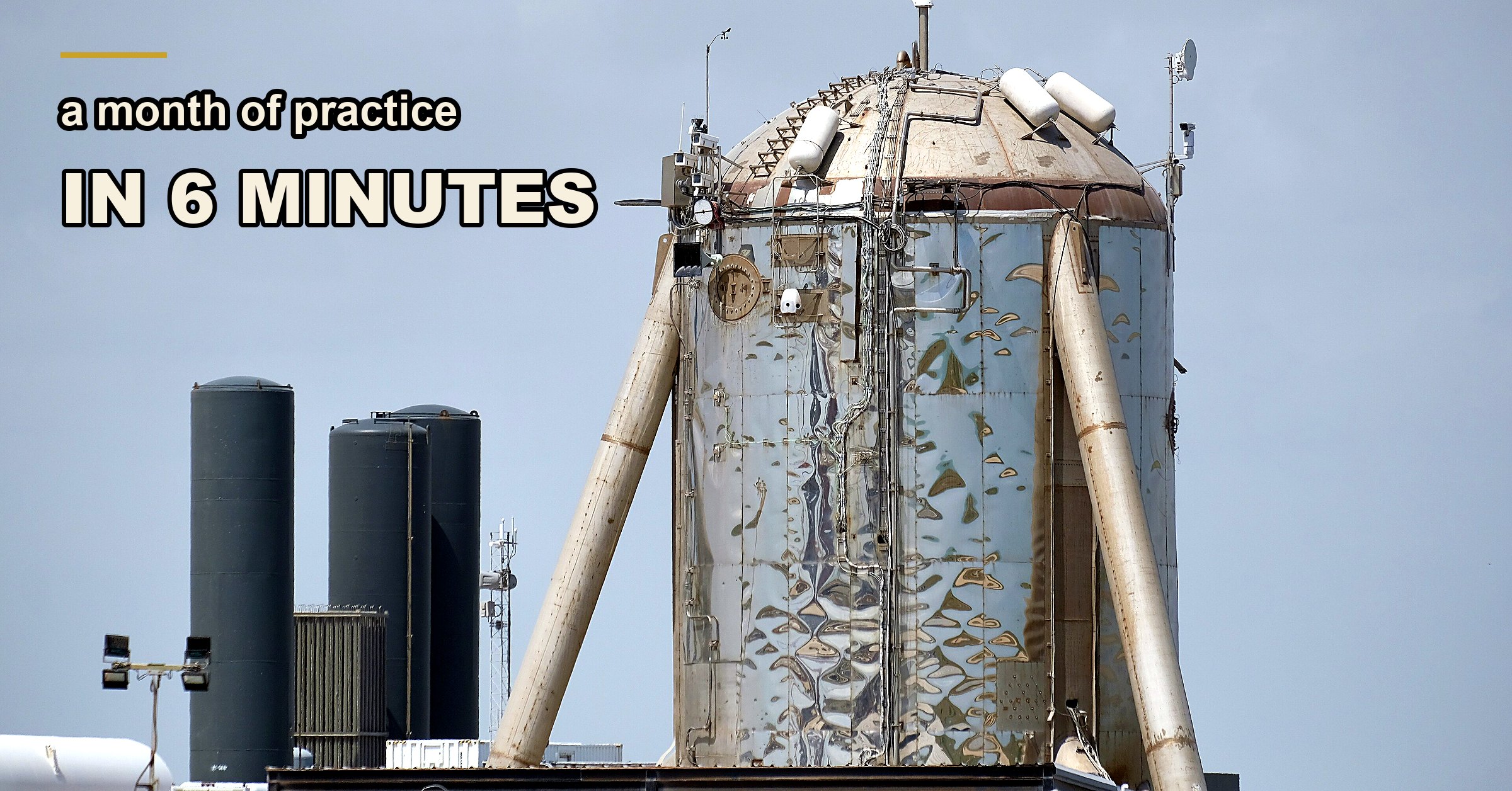
A Starship booster or ship was destroyed on 8 of its 13 flights. Whether that's too many depends on what you count, and so does the answer to how often you should be wrong.
By Peter Plötner. Aerospace engineer and Wayfinder Life Coach. More about Peter →
SpaceX's Starship has flown 13 times. On 8 of those flights, the booster or the ship didn't fulfill all its objectives before it was destroyed. On Monday, Flight 14 is set to become the first to reach orbit.
8 in 13 sounds like a terrible record. Daniel Coyle, who spent 5 years inside the small places that turn out world-class people, says you learn fastest when you're wrong about 1 time in 5. Whether SpaceX is anywhere near that depends on what you count.
What counts as one mistake?
When Coyle says 1 in 5, he means single attempts. One bar of music, one swing of a racket. A Starship flight isn't one attempt. It's a long list of them in a single launch: the engines lighting, the stages separating, the heat shield, the payload door, an engine relighting in space, the landing burn. Each flight has its own list of objectives.
Flight 13 in July is one of the 8. The ship released 20 real Starlink satellites and made contact with all of them. It relit an engine in space, came back through the atmosphere, and splashed down intact in the Indian Ocean. The booster's landing burn failed and it was destroyed. On a per-flight scorecard that's a loss. On the list of objectives it's mostly passes.
SpaceX doesn't publish a pass or fail for every objective. My guess as an engineer is that per objective, they sit much closer to Coyle's range than 8 in 13 makes it look.
The same trap works on you. Count by the quarter and one lost deal can make the whole quarter feel like a failure, while one big win can hide a lot of calls you learned nothing from. Count by the single attempt instead: one call, one pitch, one hard conversation. That's the unit where 1 in 5 means something.
The dial
Once you count per attempt, you need something to adjust. In a test program it's how many new things go into the next test.
Every Starship is a little different from the one before. Put in too many changes and, when something breaks, nobody can tell which change did it. Put in too few and each flight teaches very little. It works like a thermostat. The setting is the size of the step.
Flight 14 has plenty of new things in it: a booster and a ship that have never flown, the first try for orbit, and the first 26 working Starlink V3 satellites released into orbit. The window opens Monday at 7:15 in the morning, Texas time, if the regulators sign off in time.
The best training grounds Coyle found turn the same dial, and they turn it down hard.
Swinging without the ball
His favorite is a tennis club in Moscow called Spartak. One indoor court, in an old metal hut in a park. Between 2005 and 2007 it produced more top-20 women players than the whole United States. When Coyle walked in, he didn't hear tennis balls. The players stood in a line swinging slowly at nothing while their coach, in her late 70s, fixed a wrist here and an elbow there. At the time, nobody at Spartak played a tournament in their first 3 years.
Take the ball away and only one thing is left to get right: the stroke. That's the dial at its lowest setting.
The sharpest example is a piece of videotape. Two Australian music psychologists, Gary McPherson and James Renwick, filmed a teenage girl they call Clarissa practicing the clarinet. By their tests she had no special ear, average rhythm and so-so motivation. In one clip, 5 minutes and 54 seconds long, McPherson worked out that she was learning about 10 times faster than usual. A month of progress in 6 minutes.
The clip isn't pretty. She plays a few bars of a jazz tune called Golden Wedding, hits a wrong note, and stops. She looks at the music, hums the bar to herself, goes back, gets a little further, hits the next wrong note, and stops again. She counts per note, not per song. Each stop shows her where her edge is, and then she reaches just past it.
She had a reason to sit in it. The day before, her teacher had played her a jazz version of the tune, and she wanted to sound like that. Coyle calls this ignition. Motivation doesn't start on the inside, he says. It starts when you see someone you want to become.
He sees the same thing at Spartak. In 1997 Anna Kournikova, who had started at the club, reached the Wimbledon semifinal at 16, and Coyle says the wave of Spartak champions came after. A girl from their own court had done it, so the rest could picture themselves doing it too.
His line for the rest of us: we walk around treating a mistake as a verdict, a sign this isn't meant for us. On the tape a mistake is information. It shows where to reach next.
How often should you be wrong?
Coyle's rule of thumb is 20 percent. Get it wrong about 1 time in 5 and you're at the edge where learning is fastest. Get nothing wrong and you aren't learning. Get it wrong 4 times in 5 and you've gone past the edge. He calls that sour, and he warns that even the right number doesn't feel good from the inside. At 1 in 5 you feel wrong a lot.
There's math under the rule of thumb. In 2019 a team led by Robert Wilson at the University of Arizona worked out which error rate makes a broad class of learning algorithms improve fastest, including simple models of how animals learn. They got 15.87 percent, about 1 in 6, and called their paper in Nature Communications the Eighty Five Percent Rule. At 85 percent right, trying harder pays off most. At 50 percent right, or at 100, trying harder barely moves anything.
Places built for the edge
The first thing Coyle noticed about his talent hotbeds was that they looked junky. Cinder blocks holding up the stairs. Nobody spent money on comfort. The money and the hours went into reps.
Starship started that way. In 2019 SpaceX welded its first test vehicle outdoors at Boca Chica, and it looked so much like a water tower that Elon Musk joked water towers can fly. And Musk hires for hard conditions in public. In 2018 he wrote that there are way easier places to work, but nobody ever changed the world on 40 hours a week. He's choosing people who want that. In the same thread he added that if you love what you do, it mostly doesn't feel like work. That's Clarissa's ignition in his words.
Coyle's bigger claim is that talent isn't a gift some people are born with. It's what an environment grows, and the environment includes who is around you and what they expect. I think that holds for every human skill, the soft ones included. Each one breaks down into smaller skills you can practice. Most people never practice them, and so they look like gifts.
The week with nothing wrong in it
If you run a company, it's easy to build a week that has no mistakes in it. You take the meetings where you already know the answer and give the talk you've given before. Anything you might get wrong goes to somebody else. From the outside it looks like competence.
Coyle says the fastest learners on Earth might be 12-year-olds on skateboards, and the slowest might be the same kids in algebra an hour later. The skateboard tells them about a mistake the instant they make it, and they can try again in seconds. In the classroom the lesson washes over them and nothing tells them anything. Same kids, different setup.
Before you count anything, find the person you want to sound like. Someone whose work you'd love to be able to do, close enough that you can watch how they do it. That's what makes the wrong notes worth sitting through.
Then pick the unit, and make it something you control. Judge each attempt on whether you did your part the way you meant to, not on whether the other person said yes. Then turn the dial. A month with no mistakes means the next step should be bigger. Wrong most of the time means make it smaller, the way Spartak took the ball away.
My own 1 in 5
Mine is scaling my coaching business. Learning to coach and getting certified feels familiar to me, a lot like university exams. The business side I know a little from an earlier start-up attempt, but this is a new level.
Sales is where the unit matters most. If I counted per sale, being wrong 1 time in 5 would mean closing 4 out of every 5 people, and that probably means my price is too low. So the unit has to be smaller: sending a DM, answering someone who liked a post or left a comment, writing a follow-up. A success there means I did everything in the script right.
Flight 14 has a date, and the date has moved once already. Whenever it flies, look past whether the ship comes home. Count the objectives it met, then watch how many new things go into Flight 15.
Where in your week are you still wrong about 1 time in 5?
Frequently asked questions
When is Starship Flight 14?
SpaceX is targeting Monday, September 28, 2026, in a 75-minute window that opens at 8:15 a.m. Eastern (7:15 a.m. Central, 12:15 UTC), from Starbase, Texas. The date moved from September 22, and the flight was still waiting on its launch license when this was written. Starship dates slip often.
What is new on Flight 14?
It is the first Starship flight meant to reach orbit; earlier flights stopped just short of orbit on purpose. It carries 26 operational Starlink V3 satellites, the first working payload it carries into orbit. The plan is about 6 orbits, a deorbit burn with a single Raptor engine, and a splashdown in the Pacific west of Chile. Booster 21 and Ship 41 are both flying for the first time.
How many Starship flights have failed?
On 8 of the first 13 flights, the booster or the ship didn't fulfill all its objectives before it was destroyed (flights 1, 2, 3, 7, 8, 9, 12 and 13). Five were fully clean (4, 5, 6, 10 and 11). Several of the 8 still met most of their objectives: on Flight 13 the ship did everything planned and only the booster was lost. Source: the flight-by-flight list on Wikipedia, checked September 22, 2026.
What is the rule of 20 percent?
It is Daniel Coyle's rule of thumb from the talent hotbeds he studied for The Talent Code. You learn fastest when you get single attempts wrong about 1 time in 5. With no mistakes you are not at the edge, and at 4 in 5 you are past it. A 2019 paper in Nature Communications found a similar sweet spot, an error rate of 15.87 percent, for a broad class of learning algorithms.
How do I find my own 1 in 5?
Pick a small unit you control, like one message or one pitch, and judge it on whether you did your part the way you meant to, not on whether the other person said yes. Count mistakes per unit rather than per month or per quarter. In sales, being wrong on only 1 sale in 5 would mean closing 80 percent, which usually means the price is too low. Then change the size of the step: bigger after a month with no mistakes, smaller when you are wrong most of the time.
Two companions: Fail Faster to Get There Sooner on the first Starship flight to carry real Starlink satellites, and The Recipe Was Public. The Cooking Took 11 Years. on the practice nobody can copy. If you want a first reading on where your own life is running on somebody else's requirements, the Spec Check is 4 questions and takes about a minute.
Related essays
Your space, free
No matter where you start, it walks with you: find what you really want, and be at peace and in joy on the way. Your unfair advantage.
Make my free account