They Flew It 1,700 Times. It Barely Changed.
By Peter Plötner · · 7 min read
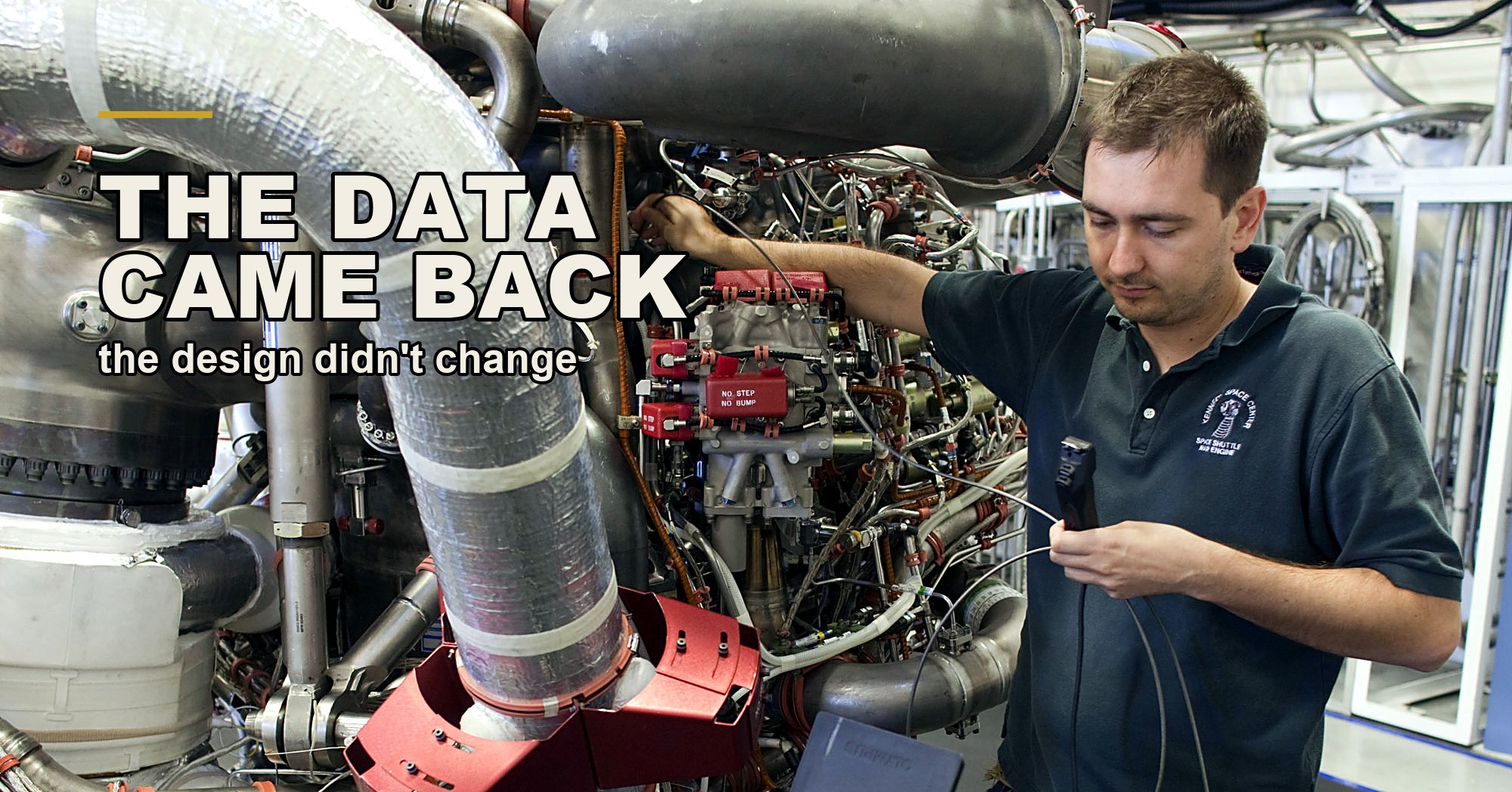
Lots of data, lots of volume, lots of fast iterations. Take away any one of the three and you get an engine that never changes.
By Peter Plötner. Aerospace engineer and Wayfinder Life Coach. More about Peter →
Soyuz has flown about 8,500 rocket engines.
The R-7 family it grew out of first flew in 1957, and it has launched more than 1,700 times since. Every one of those flights lights 5 engines, 4 out on the strap-on boosters and 1 in the middle. Add it up and you get more engine flights than SpaceX's Merlin.
For the moment. At the launch rate SpaceX is running now, that record falls inside about a year.
The engine is close to what it was in 1957. The RD-107 is one of the most reliable machines anybody has ever built, and it has been carrying people to orbit since before the Moon landing. But if flying something over and over is what makes it better, 8,500 flights should have produced something unrecognizable by now. It didn't.
I believed SpaceX had a data advantage nobody could catch. Then I did the research, and found there's more to it than just data.
The three kinds of data you can get from a rocket engine
Test firing. You bolt the engine to a stand and fire it. You control the conditions and you can cover the engine in sensors. This one isn't anybody's advantage: acceptance testing every engine before flight is normal across the industry for liquid engines. Solid motors are the obvious exception, since firing one is the same as using it up.
Flight. Real vibration, real thermal loads, real staging, real everything you couldn't reproduce on the stand. But it reaches you as telemetry, numbers over a radio link from a machine that is now scattered across the floor of an ocean or a desert.
The engine itself. The first stage lands. You take it apart, and you see where the metal thinned, and the crack that hadn't opened yet, and the part that held but only just.
You also see the opposite. You see where the engine is over-engineered: margin you never needed, and weight that cost you performance on every single flight.
That third kind is rare. Almost nobody in the history of spaceflight has had it.
What SpaceX actually has
By late August 2026, Falcon 9 has flown 694 times. Each flight lights 9 Merlins on the first stage and 1 vacuum Merlin on the second. Add 12 Falcon Heavy flights at 28 engines apiece and you land around 7,300 Merlin flights.
Then the number that started this. 651 of those boosters flew back and landed, which is close to 5,900 engines that didn't end up in the ocean. Every one of them arrived as a physical record of what a real flight does to real hardware, which is the kind of information you cannot buy, model, or infer.
This year alone SpaceX passed 100 Falcon 9 flights before the end of August, and one booster has now flown 37 times. Nearly all of this year's boosters landed, so call it 900 engines recovered in 8 months.
Starship runs on the same idea. 39 Raptors per flight, 33 on the booster and 6 on the ship. 13 flights in, and 2 boosters have now flown twice. When the first of them went up again in May 2025, 29 of its 33 engines were the same ones that had flown before: launched, recovered, inspected, and sent back up.
So the case looked closed. More engines per rocket than anybody, and the only company on Earth getting them back at scale.
Where I was wrong
| Engine | Vehicle | Lit per flight | Engine flights | Came back |
|---|---|---|---|---|
| RD-107 / RD-108 | Soyuz (R-7 family) | 5 | about 8,500 | 0 |
| Merlin | Falcon 9 / Heavy | 10 (28 on Heavy) | about 7,300 | about 5,900 |
| Rutherford | Electron | 10 | about 930 | some, 1 reflown |
| RL10 | Centaur, Delta, SLS | 1 to 2 | 522 engines since 1963 | 0 |
| Raptor | Starship | 39 | about 500 | 2 boosters flown twice |
| RS-25 | Space Shuttle | 3 | 405 | 405 |
| Vulcain | Ariane 5 | 1 | 117 | 0 |
| RD-180 | Atlas V | 1 | about 110 | 0 |
| F-1 | Saturn V | 5 | 65 | 0 |
Two rows in that table call for a deeper look.
More flights isn't the advantage. Soyuz has more. So raw count can't be the thing that makes an engine better, or the RD-107 would be a different machine by now.
Getting the engine back isn't unique either. The Space Shuttle did this for 30 years. Three RS-25 engines per flight, 135 flights, 405 engine flights, and every single one of them came back. They were pulled out of the orbiter, driven to a processing building, inspected, rebuilt, and flown again. Only 46 engines were used during the entire shuttle program. There were also more than 1,000,000 seconds of hot fire on the ground, about 280 hours.
Test firing, flight, teardown. The whole loop, closed, for three decades, before SpaceX existed.
The RS-25 became the most expensive rocket engine ever flown.
What's actually different
Rate first. The Shuttle got about 14 engines back a year. SpaceX got more engines back by August this year than the entire shuttle program returned in 30 years.
Then permission. The Shuttle could look at everything and change almost nothing. The engine carried people, so it was locked down by design, and every modification meant years and a mountain of paper.
Raptor has moved through 3 generations while Starship has been flying, but that comparison flatters SpaceX unfairly. Starship is still in development, and everything in development changes fast. Merlin is on its fourth major version and has been uprated repeatedly since, so it isn't a frozen engine either. It's a mature one, and there's only so far you can optimize a mature design before the next real gain means starting over.
The freedom that actually separates SpaceX from the shuttle program is a different thing, and it comes in three parts.
It flies cargo and people on the same rocket. A change can be proven across dozens of satellite launches before it ever sits under a crew. The Shuttle had no uncrewed version to try anything on. Every flight was the crewed flight, which is exactly why the engine wasn't allowed to change.
SpaceX is mostly its own customer. Most Falcon 9 flights carry Starlink, so a change to the rocket needs no external sign-off. No contract has to be renegotiated, and no customer has to agree to the change.
Starship is running one of the longest test campaigns in the history of spaceflight. 13 flights of a vehicle that isn't in service yet, each one another chance to change the rocket and the engine before anything gets certified for a customer.
And some decisions never reopen at all. Falcon 9 burns RP-1, a refined kerosene. The reason isn't that kerosene is cheap to buy. It's that a kerosene engine is far cheaper to develop. Merlin uses an open-cycle gas generator, the simple and well-proven way to build an engine. Raptor uses full-flow staged combustion, the hardest cycle anyone has attempted and the first of its kind ever to fly. It cost far more to develop, and the SpaceX of 2002 could not have paid for it.
Kerosene has a cost of its own. Burning it leaves carbon deposits inside the engine, a process called coking, and cleaning that out is real work between flights, so it caps how often the engine can be reused.
You can't change an engine's fuel afterwards. The pumps, the injectors and the cooling passages are all built around one propellant.
So that change had to wait for the next vehicle. And it isn't really an improvement, because if you were building Falcon 9 again today you would probably still pick kerosene. Hydrogen performs beautifully and is genuinely difficult to handle. Kerosene is easy and limits reuse. Methane sits between the two. It's the right answer for what Starship has to do, not a better answer in general.
The choice was set by what the company could afford in 2002, and it was the right call then. It just stopped being revisitable long before anyone knew what the next vehicle would need to do.
That call gets made once, at the start of an engine design process, and no amount of teardown data gets to revisit it.
The improved claim
Lots of data. Lots of volume. Fast iterations. All three at once.
Soyuz has the volume without the iterations. The Shuttle had the data and the teardowns and no permission to act on them. SpaceX is the only company that has all three, and it has the third one largely because of how the company is arranged: its own payloads to fly, cargo missions to prove changes on before humans fly with the rocket, and a test program that hasn't ended yet.
Your loop is probably too long
You already have the data. Most technical founders do: the dashboard, the quarterly numbers, the reviews.
What usually goes wrong is the timing. The measurement is real. It just comes back after the decision.
The refined version
Start with the thing that actually needs to improve. Then, for that thing, go and find something you can get lots of data on, at lots of volume, and are allowed to change.
If it doesn't exist yet, build the process that produces it.
I'm doing this in my own practice right now. What I want to know is how to make the coaching even more valuable, and what would make a client excited enough to tell someone else about it. Those two matter more than anything else I could measure, and they are also the slowest. A good result on that takes months. Referrals take even longer.
So I use proxies with much shorter loops. Reach. Interactions. Calls booked. What someone says after a single session. None of those is the thing I actually care about, and every one of them comes back fast enough to change what I do next.
The slow measure tells you whether you were right. The fast ones are where you improve 10 times faster.
So: what's the thing that most needs to improve, and what could you measure about it today?
Frequently asked questions
Does SpaceX really have more engine data than anyone else?
Not on flight count, at least not yet. The Soyuz family has flown roughly 8,500 engines since 1957, still slightly ahead of every Merlin SpaceX has launched, though at current launch rates that flips within about a year. What SpaceX has is all three at once: lots of data, from roughly 5,900 engines recovered and inspected; lots of volume; and permission to keep changing the design.
Didn't the Space Shuttle also get its engines back?
Yes, and it's the strongest argument against the simple version of the data story. All 405 RS-25 engine flights came back and were inspected, using only 46 engines across the whole program. But it returned about 14 engines a year, and because the engine carried people on every single flight, it wasn't allowed to change. The full loop existed and still produced the most expensive rocket engine ever operated.
What can you learn from a recovered rocket engine that telemetry won't tell you?
Where the metal thinned, where a crack started without failing, and which parts were closer to their limit than the numbers suggested. Also the reverse: where the engine is over-engineered and carrying margin, and therefore weight, that it never needed.
Why does Falcon 9 burn kerosene and Starship burn methane?
Mostly because of what the engine costs to develop, not what the fuel costs to buy. Merlin burns kerosene and uses an open-cycle gas generator, the simple and well-proven way to build an engine. Raptor burns methane and uses full-flow staged combustion, the hardest cycle anyone has attempted and the first of its kind ever to fly, and it cost far more to develop. Early SpaceX could not have afforded to start there. Kerosene's own drawback is coking, the carbon left inside the engine after burning, which caps reuse. An engine cannot change fuel later, since the pumps, injectors and cooling are all designed around one propellant, so the change could only come with a new vehicle.
How does this apply to running a company?
Start with the thing that actually needs to improve, then look for something about it you can get lots of data on, at lots of volume, and are allowed to change. Where the thing you care about most is slow, such as how valuable the work was to a client or whether they tell anyone about it, find shorter-loop proxies you can steer by, and treat the slow one as the check on whether you were right.
One thing that closes soon. I just earned my certification as a Wayfinder coach, and to mark it I am giving away my full 3 month coaching package to 1 person, free. It is the same package paying clients get: a session every 2 weeks, support in between by message or voice, and the method itself, so you can run it again on your own later. No homework. I read every application myself and they close on September 20. If you have been measuring something carefully for a while and nothing has changed because of it, the application is here and takes about 5 minutes.
The companion pieces are What Did You Put on the Test Stand This Week? on leading indicators you can actually watch, and The Problem You Want to Solve Isn't the One in Your Way on finding the constraint that is actually binding. If you want a first reading on where your own loops are too long, the Spec Check is 4 questions and takes about a minute.
Related essays
Your space, free
No matter where you start, it walks with you: find what you really want, and be at peace and in joy on the way. Your unfair advantage.
Make my free account