The Answer Was 42
By Peter Plötner · · 6 min read
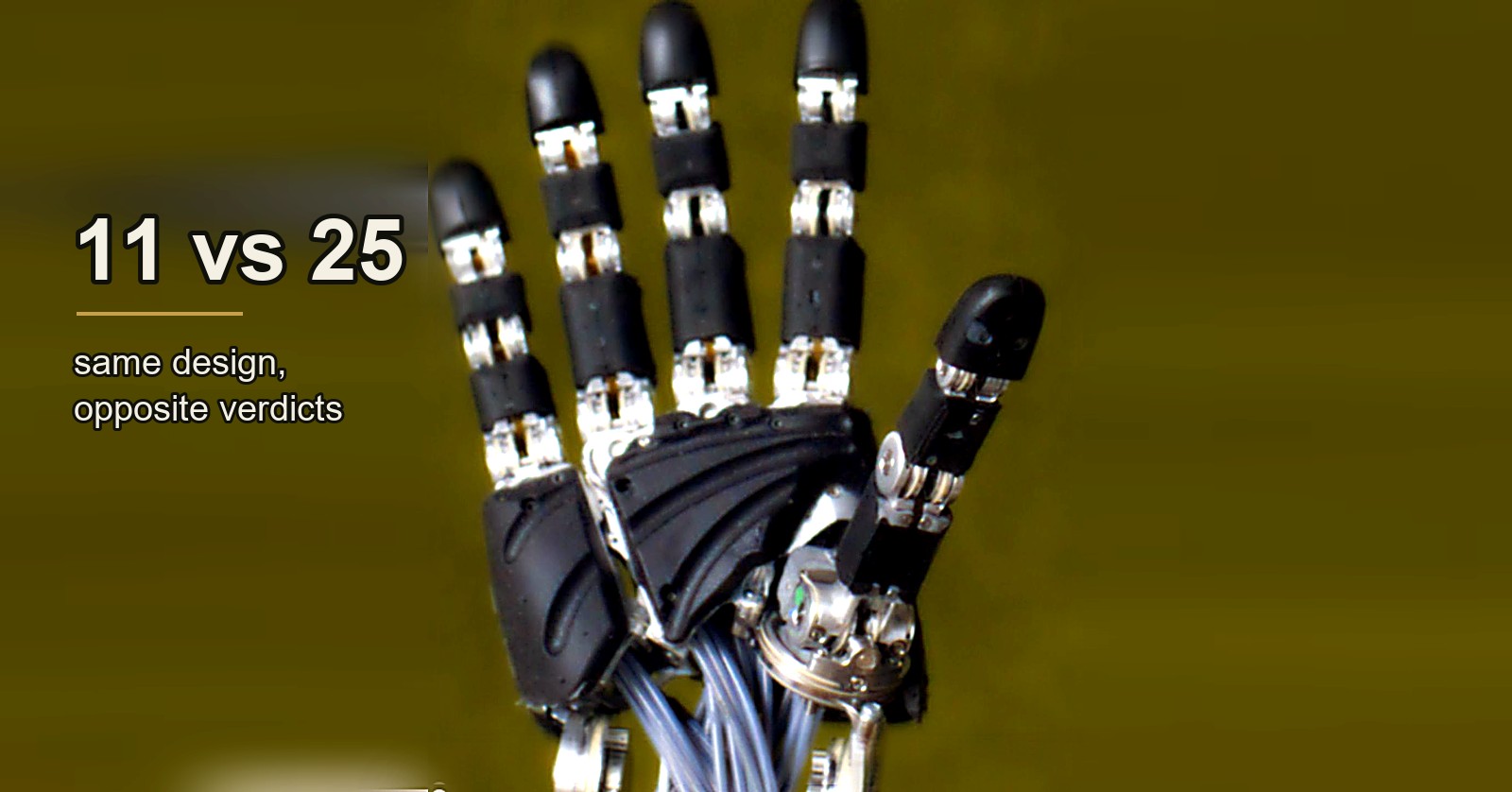
Figure and 1X disagree about how to build a robot hand. The argument is really about why a decision that works is the thing that stops you.
By Peter Plötner. Aerospace engineer and Wayfinder Life Coach. More about Peter →
Figure is on its 7th robot hand, and it threw out the one design 1X still ships.
Figure's CEO, Brett Adcock, explained why this week. He calls that design a complete local maximum. Not broken. Just as high as it is ever going to go. Which is also the most expensive thing that can happen to a decision that worked.
Some numbers for scale: Figure has shipped 3 versions of its robot and 7 versions of its hand. The first hand, from 2022, pulled the fingers with tendons, thin cables running back into the forearm. It was the obvious choice. Real hands work that way, and you get the motors out of the fingers and into the arm where there is space. Adcock now calls it one of the worst engineering decisions he has made.
That phrase he used is worth taking apart.
What a local maximum actually is
Picture yourself walking in fog, looking for the highest point in a landscape. You can only feel the ground right around your feet. So you use a simple rule: always step uphill.
It works. You climb. Then you reach a spot where every direction goes down, and you stop.
You are at the top. Of a hill. The mountain is 2 kilometers to your left and you will never find it, because finding it means walking downhill first, and your rule says never do that.
That is a local maximum. Not a failure. The opposite of failure, which is exactly what makes it so quiet. Every single step you took was an improvement. The trap was never the steps. The trap was the rule.
Why you cannot feel it from up there
Now the good part. 1X did not agree, and neither did Andrea Esposito, who leads mechanical design at Foundation. He wrote back publicly: tendons are fine. Figure's hand had only 11 degrees of freedom, a weak wrist, and cables routed through tubes badly enough to add friction.
So the two of them are not really arguing about the same thing. Adcock is judging the approach. Esposito is judging how well Figure carried it out.
1X publishes numbers on it. Its NEO hand runs the same architecture, tendons through the wrist to motors in the forearm, at 25 degrees of freedom: 22 in the hand and palm, 3 more at the wrist. Wear is a case against tendons, because cables stretch and fray. 1X rates that hand at more than 2 million cycles.
So two serious teams look at the same mechanism and reach opposite answers. Both have real evidence. Adcock's evidence is his own hand. Esposito's evidence is somebody else's.
And this is why you cannot settle it by standing there and feeling around. From the top of a small hill, every direction goes down. From the top of the mountain, every direction also goes down. Standing on either one, the ground tells you the same thing. The fog does not care which peak you found.
The downhill part nobody can hand you
None of this stays in robotics. The same thing happens the moment somebody hands you an answer.
Usually it is a good answer, paid for with real scars. You use it, it works, you get a quick win. The win is what makes it expensive, because once it worked you stopped asking.
One problem you can see coming: their answer was shaped by their requirements and not yours (Which Robot Has the Best Hip?).
The harder one shows up even when the advice fits you perfectly. An answer arrives as a direction, and that direction was worked out on somebody else's map.
And the maps are not of the same place. Everyone walks in carrying something different: what they are good at, what they can stand, who is waiting for them at home, how much money is left. All of it changes the shape of the ground under their feet. No two of us are standing on the same terrain, even when we are working on what looks like the same problem.
That is why the downhill stretch is the part nobody can hand you. On your terrain it starts somewhere else, and you are the only one standing on it.
The answer was the cheap part
In The Hitchhiker's Guide to the Galaxy, a computer runs for 7.5 million years to find the answer to life, the universe, and everything. It returns 42. Correct. Completely useless. Nobody had ever worked out what the question was.
So they build a bigger computer to find the question instead.
That is the joke and it is also the whole thing. The answer was the cheap part. And the one genuinely useful line in the entire Guide is not an answer at all. It is printed on the cover in large friendly letters: Don't Panic. A state, not a solution.
What moves you off a hill
There is really only one way off a local maximum. You go and feel the ground somewhere else.
And rarely just one somewhere else. A single new spot can easily be lower than the one you left, and then you have learned almost nothing. Several of them give you a real chance at higher ground. This is why nobody solving it properly restarts once. They restart from a lot of different places and compare.
This is the whole job, and it is not somebody describing the view from where they happen to be standing. It is somebody making it possible for you to step off the top, more than once, and look from places you would not have walked to on your own.
So, plainly, because I get asked: I do not have your answer. You know your situation in a detail I will never reach. What I have is questions that are open, that do not point anywhere, that you cannot close with a yes or a no, asked from outside the spot you have been standing on. My job is to make the space safe enough, and the questions clean enough, that you can afford to look.
That is the difference between the two things sold under the word coaching. Someone giving you the answer moves you up the hill you are on, fast, and that is worth paying for. I would buy it for a tax problem, a term sheet, a bug in production. Someone giving you a way to find your own questions can change which hill you are on.
That one is more exposed. It only works if you are honest with yourself, which is the actual price. Not money. Vulnerability.
Adcock did not learn his ceiling from advice. He built the hand, shipped it, lived with it, and 7 generations later he can say it in one sentence. Nobody could have handed him that, and if someone had, he would have held a fact without the understanding underneath it, which is nearly the same as not knowing. A question cannot build the hand for you. It can get you looking somewhere else, sooner.
What situation of your own came to mind while you were reading this?
Frequently asked questions
What is a local maximum, in simple terms?
It is the top of a small hill. Every direction from where you stand goes down, so you stop climbing, even though a much higher peak sits nearby. It happens whenever your rule is “always improve from here,” because that rule can never take you downhill, and reaching a bigger peak usually starts with going down.
What is the difference between coaching and consulting?
A consultant or mentor gives you an answer that worked for them or for their other clients. A coach gives you open questions and enough safety to use them, so you can look at your situation from places you would not have gone on your own and find the answer that fits it. Both get sold under the word “coaching.” They do different jobs.
Is advice bad, then?
No. Advice is fast and often correct, and for a well-defined problem with a known answer it is the right purchase. Tax, contracts, a technical bug, a regulation. The limit shows up when the question is about direction, because whoever answers worked it out on their own terrain, and yours is shaped by things they are not carrying.
How do you know if you are stuck at a local maximum?
You usually cannot tell from the inside, which is the whole difficulty. The ground feels the same on a small hill and on a mountain. What you can check is whether a major decision has gone a long time without being revisited, and whether you have looked at it from anywhere other than the spot you already stand on. One other viewpoint is rarely enough, because it can easily be worse than where you started. Several, compared against each other, is what tells you something.
What makes a coaching question different from a piece of advice?
An open question has no answer hidden inside it. It cannot be closed with yes or no, and it does not point at the reply the asker already has in mind. “Have you thought about hiring a COO?” is advice with a question mark on it. “What is the part of this you have stopped looking at?” is a question.
The companion pieces are Which Robot Has the Best Hip? on copying the reasoning instead of the answer, and The Problem You Want to Solve Isn't the One in Your Way on finding the one constraint that is actually binding. If you want to see which part of your own map you have stopped looking at, the Spec Check is 4 questions and takes about a minute.
Related essays
Your space, free
No matter where you start, it walks with you: find what you really want, and be at peace and in joy on the way. Your unfair advantage.
Make my free account