Change the Plan, Not the Vision
By Peter Plötner · · 7 min read
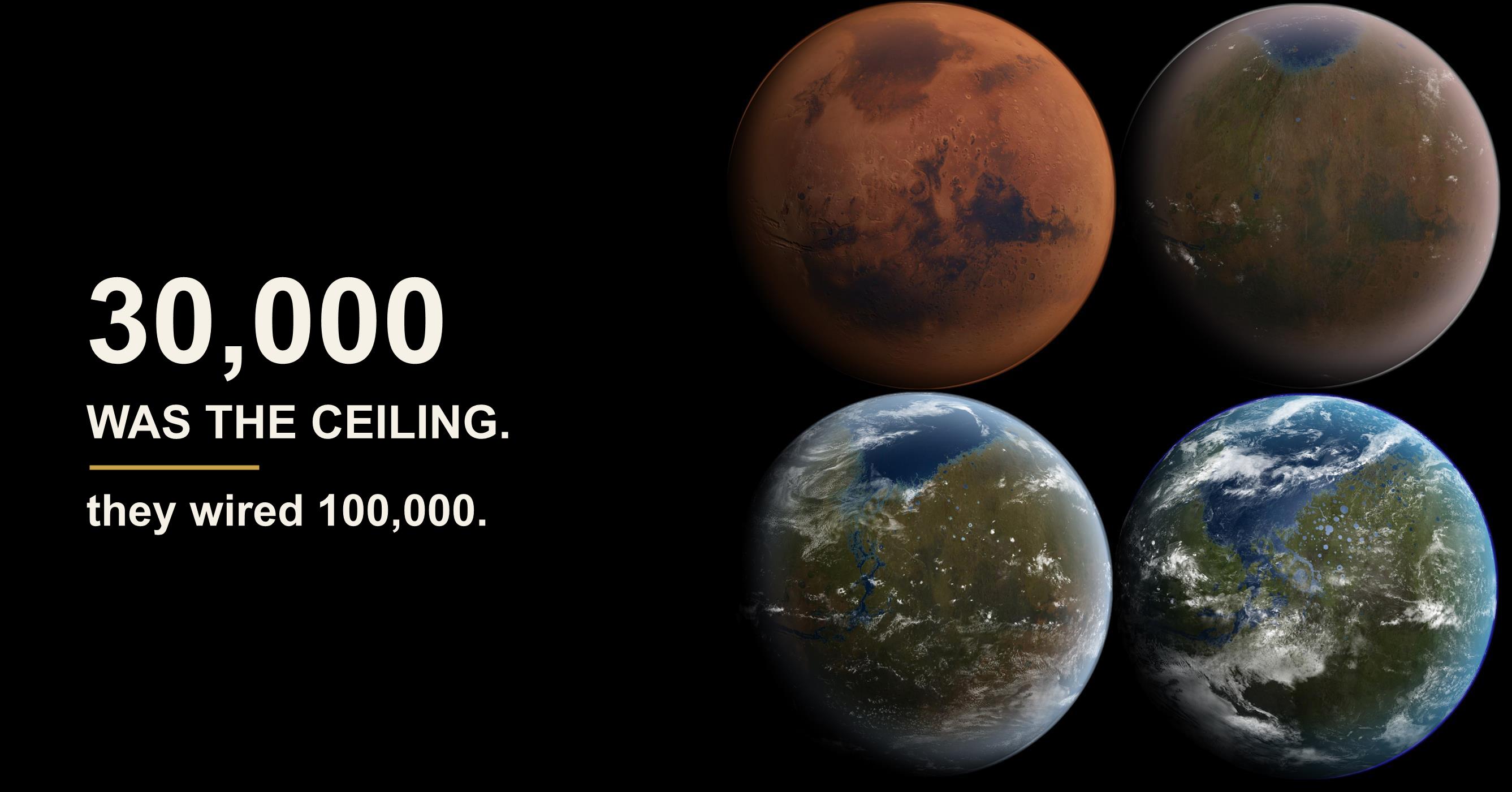
For twenty years SpaceX has scrapped plan after plan. The one thing it keeps steady is the reason all of them turn into fuel.
By Peter Plötner. Aerospace engineer and Wayfinder Life Coach. More about Peter →
Elon Musk built the world's largest supercomputer to train an AI that could beat Anthropic. Anthropic now runs its own AI on that machine, and pays about 1.25 billion dollars a month to do it.
That is not a defeat, and it is not a retreat. Under it sits a goal that has held for twenty years, and that steadiness is the part most founders get backwards.
What SpaceX actually did
On August 4, SpaceX reported its first earnings as a public company. Revenue was 7.8 billion dollars for the quarter, almost double a year earlier. Starlink was the big engine. The line worth reading twice was the one under it.
SpaceX has an AI arm now. Earlier this year it absorbed xAI, Musk's AI company, the one behind the Grok chatbot. To train Grok, xAI needed more computing power than almost anyone on Earth. So it built Colossus, in an abandoned appliance factory in Memphis: a hundred thousand Nvidia H100 chips, the kind that train the most advanced AI, wired into a single machine in 122 days. For years, about thirty thousand chips was the most anyone could wire to run as one brain, past which keeping them all in step fell apart. Getting beyond that was the hard problem, and building anything this size normally takes years. Then they doubled it in another three months, and they are still building toward a million.
The plan was to beat the leaders with that machine. Then something more useful happened. Instead of keeping all of Colossus for itself, SpaceX rented most of it out, to Google and to Anthropic, one of the very labs it was racing. Anthropic alone signed up for about 1.25 billion dollars a month, into 2029. That is roughly 15 billion dollars a year, against a machine that cost around 16 billion to build. It pays for itself in about a year.
And here is the part that matters. Grok is not winning the popular race. Next to ChatGPT it has a small slice of users, a distant fifth. On raw skill it holds up, it leads some tests and costs less to run, but on getting people to actually use it, it is behind. And that does not matter to the machine. Win the users or lose them, Colossus still rents, and the rent still pays for rockets. This is not a bet that failed. It is a machine built for one job, now doing two, and paying for itself either way.
The thing that didn't move
Here is what makes that possible, and it is not luck and not genius.
Musk has said the same sentence for twenty years. The point of SpaceX is Mars. Everything else is a way to pay for Mars. Launch pays for Mars, and reusable launch is what made the rest possible. Starlink pays for Mars. And now a supercomputer in Memphis pays for Mars.
Look at how much has changed underneath that one steady line. SpaceX was going to land a Dragon capsule on Mars, called Red Dragon. Dropped. It was going to land its crew capsules on the ground with rockets instead of parachutes. Dropped. The order changed too, with the Moon now a stop on the way. Plan after plan, and the sequence itself, swapped again and again for two decades. Mars never moved.
Even the boldest-sounding new move is still a plan, not a new destination. On the day of those earnings, SpaceX said it will put the data centers themselves in space: up to a million satellites carrying Nvidia's newest chips, computing in orbit and beaming the answers back to Earth. That sounds like a different company. It is not. It is one more road to Mars, compute that pays the bills, and practice at running hardware off the Earth, which is the whole job anyway.
That is why the compute move is not a swerve. Win the model race, and the money funds the rockets. Rent the machines out, and the money still funds the rockets. Both roads run to the same place. When the goal at the top holds still, “win” and “lose” on a smaller bet stop being opposites. They become two different-shaped ways of feeding the same thing.
No one has to say yes
Here is the part I would most want a founder to take. That Mars line does not wait on anyone's permission.
SpaceX does not need to win the AI race for the plan to hold. It does not hang on one customer or one contract. It builds its own roads and owns them: Starlink, launch, now Colossus for rent. The money comes from what it owns, so no single buyer, no single investor, and no lost race gets to decide whether it keeps going. The outside world can say no to any one plan. It cannot say no to the vision, because the vision does not run on an outside yes.
That is the quiet strength under all of it. You do not need ten bets running at once; parallel is harder, not easier. You need each try, win or lose, to leave something the vision keeps: a lesson, an asset, a road. A vision that hangs on one big yes is one someone else can switch off. A vision that turns every try into a data point is one you get to keep.
The layer you change least
A lot of what I write is about questioning the requirements you run your life on. The job you shaped yourself around. The company you built. When they stop fitting, that is a signal to re-spec them, not to grit your teeth.
This is the other half of it. You re-spec the plans freely. The vision, the thing at the very top, you change least often, most carefully, and when it truly changes, most boldly. You change it least often because a target you keep moving is one you can never actually walk toward.
That does not mean never. You can and should ask what you really want, going a few levels down, until you reach something with no “why” left under it. That deep answer does move sometimes, and when it really does, you follow it all the way. But there is a right way for it to move. A true change of direction comes from something quiet and clear. It does not come from the sting of a plan that just failed. When a bad quarter rewrites your whole “why,” you may not be re-spec'ing your vision at all. You may just be flinching, and only you can feel the difference.
The overnight successes almost always turn out to be ten years in the making. The ones who get there usually held one direction for a long time and kept fixing the process underneath it. A steady vision is not the slower path. Over a long enough run it is the faster one, because every setback compounds into the same account instead of scattering.
What this looks like when you are not SpaceX
You do not have a 16-billion-dollar supercomputer to re-point. You have the same machine at your own scale.
Picture the founder who bet a year and half the team on a product line that did not land. Measured against “make this product win,” the year is a loss and little else. But most founders, honest with themselves, were after something underneath the product. A certain kind of company. A problem they cannot stop caring about. A life that feels like theirs.
Held against that bigger thing, the dead product line is not only a loss. It is a team that learned to ship, a market they now understand, a clear list of what does not work, sometimes a thing they built for one job that quietly fits another. The same facts are worth almost nothing against the small goal and quite a lot against the vision.
The move is not to pretend it worked. SpaceX did not pretend Red Dragon flew. The move is to hold a vision steady enough that a setback turns into something you can use, instead of just a hole in the year.
What to do when a bet comes up short
So the next time a bet of yours comes up short, the useful question is not “how do I win it back.” Ask what the bet was really for. If you can name the thing above it, and that thing has not moved, you already know what the setback feeds. It feeds the same place everything else does. And if you cannot name the thing above it, that is the more useful challenge, and it is worth more than the bet you just lost.
Frequently asked questions
What did SpaceX's first earnings report show?
On August 4, 2026, SpaceX reported 7.8 billion dollars in quarterly revenue, almost double the year before. Most came from Starlink. Its AI arm booked about 2.6 billion, much of it from renting out computing power to Anthropic and Google. The company still posted a net loss of 541 million as it spends heavily on rockets and AI.
Why does SpaceX rent its supercomputer to Anthropic, a rival?
It built Colossus, in Memphis, to train its own AI (Grok). Rather than keep all that capacity for itself, it rents most of it out at a high margin. Anthropic pays about 1.25 billion dollars a month into 2029, which roughly pays back the build in a year. Grok itself holds up on capability but is far behind on users, a distant fifth, and the rental income does not depend on Grok winning.
What does “change the plan, not the vision” mean for a founder?
Keep your top goal steady and change the plans beneath it freely. When the vision holds, a failed plan becomes an input to it, a re-pointing, not a dead end.
Doesn't a vision have to change sometimes?
Yes, but least often and most carefully, because a target you keep moving is one you can never walk toward. When it truly does change, you follow it boldly. The test is where the change comes from: something quiet and clear, not the sting of a plan that just failed.
How do I find the thing above my bets?
Name what your last hard bet was really for, underneath the specific outcome. If you can say it in one plain sentence, check whether it has actually moved. If you cannot, that is the thing worth working on first.
If this one landed: Reusable Rockets, Disposable Joy is on what a vision is actually for, and The Thing You Built Stopped Fitting You is on the plans you are allowed to re-spec. And if you cannot yet name the thing above your bets, the Spec Check is one place to start looking.
Related essays
Your space, free
No matter where you start, it walks with you: find what you really want, and be at peace and in joy on the way. Your unfair advantage.
Make my free account