Which Robot Has the Best Hip?
By Peter Plötner · · 6 min read
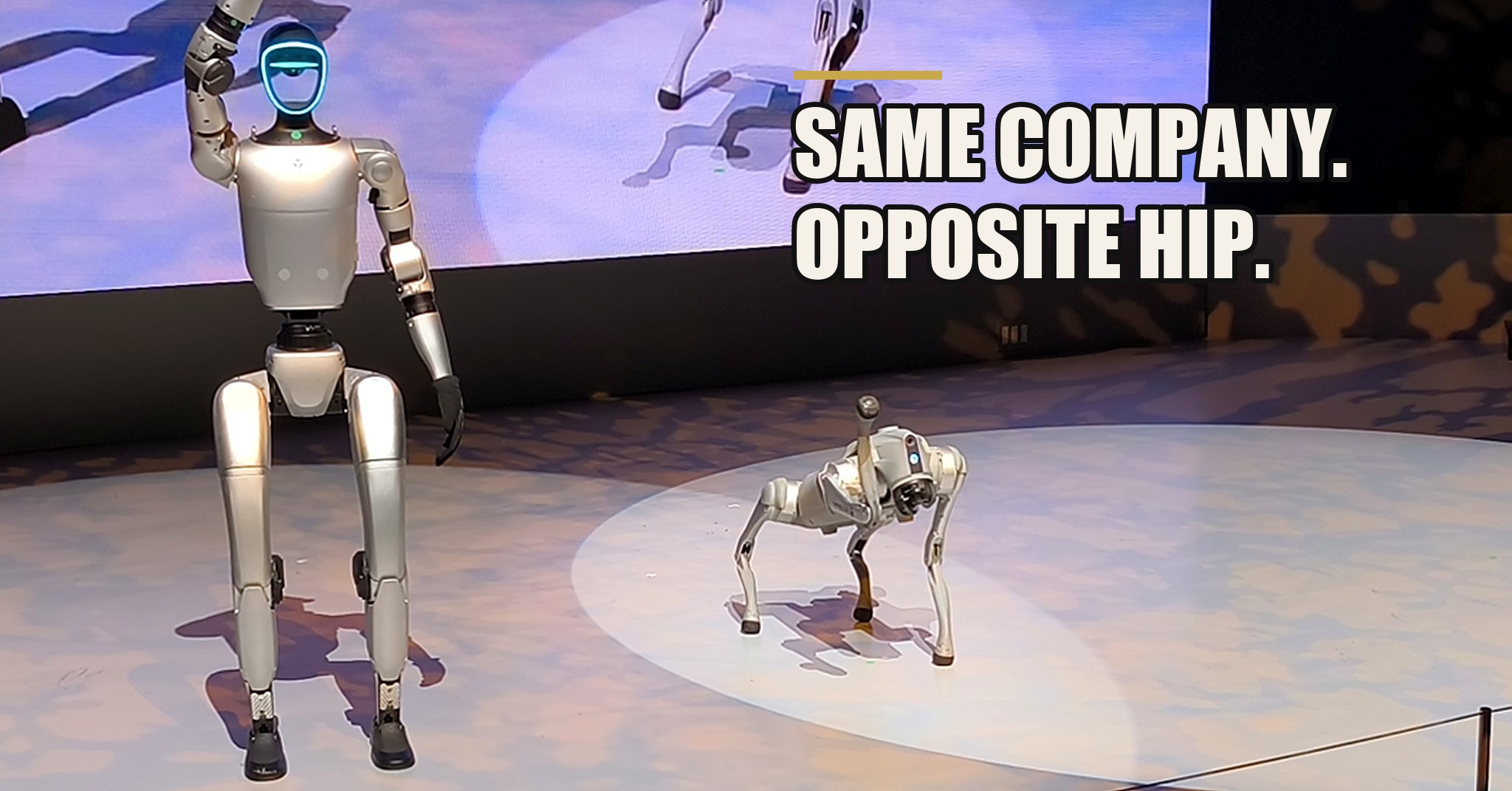
The best robot makers in the world cannot agree on how to build a hip. That is not a flaw in the field. It is the answer, and it is one you can use.
By Peter Plötner. Aerospace engineer and Wayfinder Life Coach. More about Peter →
Last year Unitree flipped the order of the joints in its newest robot's hip, the exact reverse of the design it shipped the year before.
I need that reminder in my own life more than I would like. I do not want to live the way most people I know live, and most of them would not want mine. For a long time I quietly assumed one of us had to be doing it wrong.
Stay with the robot for a second. A humanoid hip is not one joint. It is three, stacked in a row from the pelvis down: one that swings the leg forward and back, one that moves it out to the side, and one that twists it. On paper, any order gives the same range of motion. But the order you stack them in changes how the robot is built and how much weight the leg has to swing. It is a real choice, the kind of small, buried decision engineers argue about for years.
So which one is right?
For a while the story was that everyone was landing on the same answer. Newer robots kept putting the forward-and-back joint first, closest to the body, and it started to look like the field had found the best hip.
Look closer, and there is no single answer. Serious teams have gone opposite ways, on purpose.
Unitree's own robots make the point. Its first big humanoid, the H1, stacked the joints one way. Its newer G1 stacks them in the exact opposite order. Same company, about a year apart, reversed.
And the reason the newer way looks better is narrow. Putting the forward-and-back joint up high gives the robot a longer stride and cleaner packaging. It looks right. But it is not free. The older order kept the heavy joint low, so the leg had less weight to swing, which matters enormously if you want the robot to move fast or run. This is not a hunch. A 2025 engineering paper on a running robot deliberately chose the old order, the heavy joint last, to keep the legs light, and pointed out that respected robots like HRP-2 and Valkyrie do the same.
So one order is better for looking human and taking long strides. The other is better for running. Neither is the best. Each is the best for a different thing.
And those are just the robots playing the same game. Others make an entirely different bet. Boston Dynamics' newest Atlas uses hip joints that spin in full circles, far past any human leg. That buys range and capability most robots do not have, and, like every choice here, it pays for it somewhere, in weight, in control, in complexity. Agility's Digit walks on backward-bending bird legs with springs in them, a bet on efficient walking that the company is now partly reversing, switching its next model to human-style knees. 1X's robot is pulled by tendons instead of stacked joints, a bet on being quiet and soft enough to live in a house. Different goals, different machines.
One more honest note. Most of what people “know” about these hips is a guess. Among the big commercial robots, only Unitree publishes the real blueprint. The rest is read off photos and teardowns. Tesla's Optimus is widely believed to use the older, heavy-joint-last order, but Tesla has never actually said. So the neat chart of “who uses which hip” is mostly inference resting on a couple of solid facts.
What the good teams actually copy
Here is the part worth stealing. The teams doing this well are not copying each other's hip. They are copying each other's reasoning. They ask what they are optimizing for, running, or price, or looking human, or fitting through a doorway, or lasting years with the least maintenance, and they let that answer pick the joint order. The teams doing it badly copy the leader's design because it is the leader's, and inherit a hip tuned for a goal that was never theirs.
What a hip has to do with your life
You already see where this goes.
There is no best way to build a life either, and yet we keep reaching for someone else's answer. The morning routine that made someone else calm. The career ladder that made someone else proud. The definition of success you were about to adopt whole. Every one of those is a joint order, tuned to what that person was optimizing for. Take it as yours and you inherit their requirements, which are almost never the same as yours.
And sometimes it is worse than copying. Sometimes you never notice you had a choice at all.
As an engineer, I know there is rarely one best answer. The whole job is “it depends.” So it is strange that in my own life I kept missing something simpler than a trade-off. In whole areas, I did not see there was a choice to make. I took the path in front of me as the way things were, the way you might assume a leg has to bend forward because yours does. Watching people I respect build lives nothing like mine is what finally showed me the joints could go the other way. The options had been there the whole time. I just had not known to look.
So where do you start?
Before you copy the answer, copy the question. When something is clearly working for someone you admire, do not ask “what did they do.” Ask “what were they optimizing for, and am I optimizing for the same thing.” Most of the time it is not, and the moment you see that, their answer stops being the answer and becomes one option among many, most of which were never built for you.
And where you feel no choice at all, get suspicious. That flat certainty that “this is just how it is” is usually not a law. It is a joint order someone chose a long time ago, for reasons that may have nothing to do with you.
The best robot makers in the world cannot agree on how to build a hip, because there is no best hip. There is only the best hip for what you are trying to do. Your life is the same. Stop hunting for the design everyone agrees on. Go find out what you are actually building, and let that pick the joints.
Frequently asked questions
Why does the order of a robot's hip joints matter?
Every order gives the same range of motion, but the physical stacking changes how the robot is built and how much weight the leg has to swing. Put the big forward-and-back joint high and you get a longer stride and cleaner packaging; put it low and the leg is lighter and can move faster. The order is a trade-off, not a detail.
Are humanoid robots converging on one hip design?
There is a real drift toward putting the forward-and-back joint first, but it is not a settled best. Unitree reversed its own design between models, a 2025 running-robot deliberately chose the opposite order to keep the legs light, and the most famous humanoid is widely read as sticking with the older order. It is a trade-off, not a winner.
Which humanoid has the best hip?
None, and that is the point. The best hip depends on what the robot is optimizing for: running, price, looking human, fitting a space, or lasting with little maintenance. And some robots, like Boston Dynamics' Atlas, Agility's Digit, and 1X's tendon-driven robot, make such different bets that they are barely answering the same question.
What does “copy the reasoning, not the answer” mean?
When you admire how someone solved a problem, copy how they decided, not what they landed on. What were they optimizing for? Are you optimizing for the same thing? Their answer was tuned to their requirements. Borrow the way they got there, not the result.
How do I apply this to my own life?
Before you adopt someone's routine, career move, or definition of success, ask what they were optimizing for and whether it matches what you actually value. If it does not, their answer is one option, built for a life that is not yours. And where you feel no choice at all, check whether that is true or just a default you never questioned.
If this one landed, Don't Outsource Your Vision is its sibling, on not handing your vision to the outside, and Stop Optimizing Your Life. Start Specifying It. is the piece on finding the requirement under the answer you were about to copy. And if you know someone quietly rebuilding their life around someone else's blueprint, send them this.
Related essays
Get new essays by email
New essays, plus the occasional thing I only send by email.