SpaceX Is Boeing in 1929
By Peter Plötner · · 6 min read
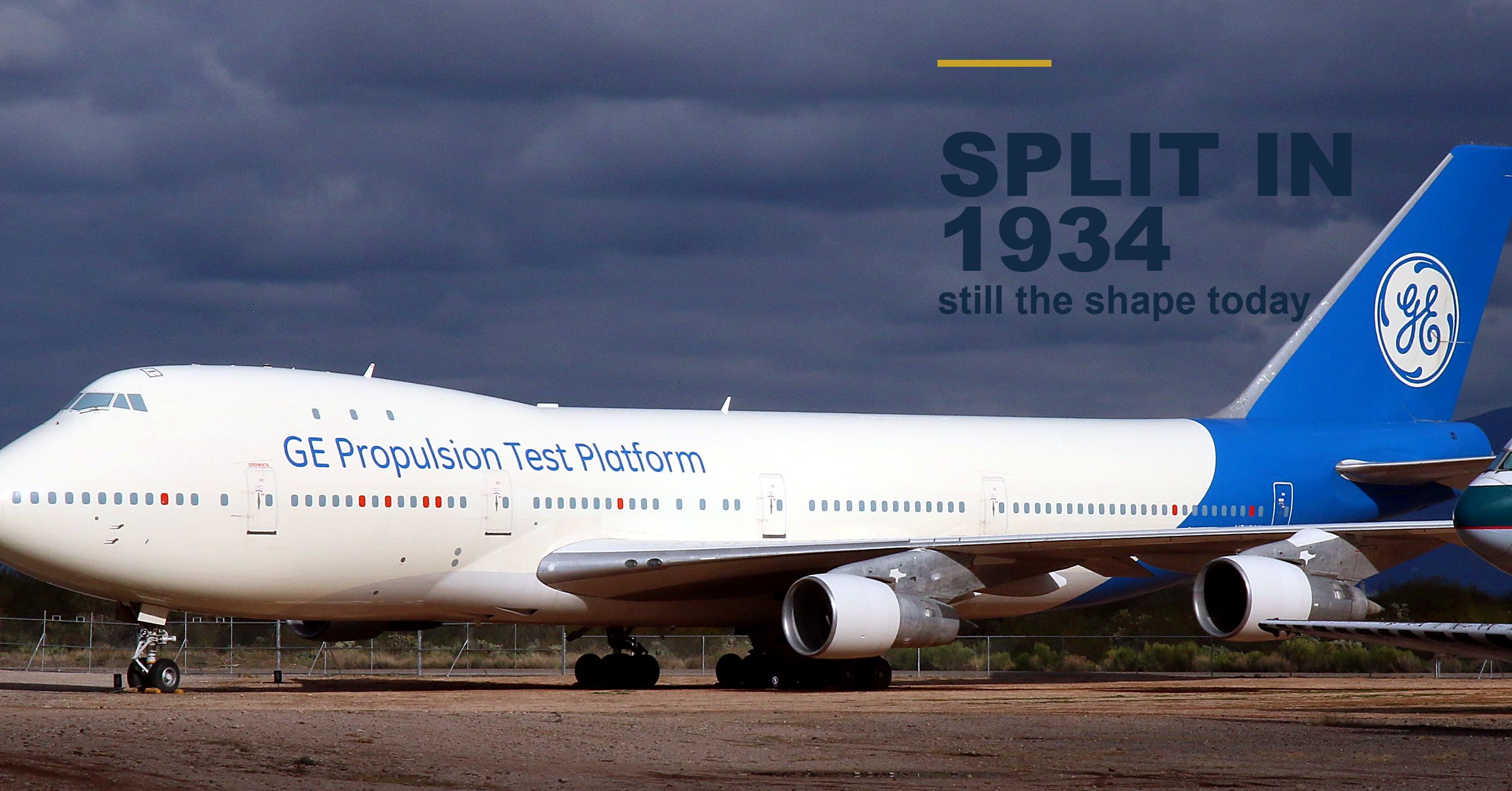
Where a market splits is a way in that doesn't require beating the leader.
By Peter Plötner. Aerospace engineer and Wayfinder Life Coach. More about Peter →
Boeing sells you the 787. It doesn't sell you the engines.
An airline picks those separately, General Electric or Rolls-Royce, the way you would pick a supplier. Same airplane, two possible engines, and neither one is made by the company whose name is on the tail.
Most people assume the engine comes with the plane, the way a motor comes with a car. It hasn't since 1934, and the companies that make the engines earn a very large share of the money in aviation. If you're building a company behind a leader, that split is the way in.
The engine is its own business
Large commercial aviation settled into a shape: 2 airframe makers, 3 big engine makers (GE, Pratt & Whitney and Rolls-Royce), and joint ventures between them.
The engine isn't a component. It's a product with its own certification, its own customers, and a service business that runs for decades after the sale. Engine makers earn much of their money keeping engines running for 20 or 30 years. Rolls-Royce charges airlines by the flying hour.
So there are two businesses inside every airliner, and they belong to different companies.
This wasn't natural. A law did it.
In 1929, Boeing and Pratt & Whitney joined into one holding company that also owned United Air Lines, Sikorsky, and Hamilton Standard propellers. One corporation built the engine, built the airplane, and flew the passengers.
Then came the airmail scandal, and the Air Mail Act of 1934 said an airline and the companies building its equipment could no longer be owned together. On September 26, 1934 the group was broken into three: the airline, Boeing for airframes, and United Aircraft, which kept Pratt & Whitney and the engines.
It was meant as a punishment. It became the shape of the industry for the next 90 years, and the engine business did better on its own than it had as somebody's department.
Nobody designed that. It was imposed, everyone adapted, and the new shape beat the old one.
Rockets are where aviation was in 1930
SpaceX builds its own engines, tanks, avionics and capsules. Rocket Lab builds its own. Blue Origin builds its own. One roof, one company, one person who can decide.
That's the right way to build while the technology is young and the interfaces haven't settled, because you can't buy a part nobody has agreed how to specify. Boeing and Pratt were under one company in 1929 for the same reason.
But the split is starting.
Blue Origin sells the BE-4 to ULA, which flies it on Vulcan, a rocket Blue Origin has nothing else to do with. Ursa Major builds rocket engines and launches nothing. Its engines are small, 5,000 pounds of thrust next to the BE-4's 550,000, but Phantom Space ordered more than 200 of them.
A small market, and a real one.
Why the split is the interesting place to stand
If you're behind, the fight everybody imagines is “build a better Starship.” That fight takes 14 years and a fortune, and the target keeps moving.
The other fight is to be the engine that every rocket company which isn't SpaceX buys.
That doesn't require beating the leader. It requires being better than each competitor's in-house propulsion team, a much smaller bar, and it turns your rivals into your customer list.
Markets that start as one lump tend to split into separate businesses, and somebody ends up owning each one. The question worth asking early is which business you actually want, not how to hold on to all of them.
The split works from the buying side too. Airbus put a widebody into service 4 years after it was founded, and the pace was possible for one big reason: the engine already existed. Airbus sized the A300 around General Electric's CF6, built for the DC-10, and spent its own 4 years on the airframe.
Buying the engine is also the biggest de-risking move on the table. The engine is where much of a new vehicle's development money and failure risk lives. Aviation's split moved that risk into companies whose whole business is engines, and those companies turned out to be the durable ones. Rolls-Royce went broke in 1971 and is one of the big 3 today. Safran and MTU build engines without building a single airliner. A rocket industry that splits the same way would give a new vehicle company the start Airbus got: the hardest part already proven, available to buy.
The thing the split makes possible
Because a jet engine is its own product, it has to be proven on its own, apart from any one airplane. GE can't wait for a new Boeing to test a new engine, because it also sells to Airbus. So the engine makers keep their own flying laboratories.
GE ran a 747 built in 1969 that certified 11 engine types and close to 40 variants before it was retired. Rolls-Royce flew one built in 1980 until 2025. Pratt & Whitney uses 747SPs.
The new engine goes on the old airplane. Nobody debuts a new engine and a new aircraft on the same morning.
An integrated company has no reason to keep a testbed like that. Engine and vehicle are built by the same people, on the same schedule, for each other, so they get tested together and they fly together. When something goes wrong on the first flight, you're reading a result with several new things tangled up in it.
Rockets mostly do change everything at once. The exceptions are the interesting part.
In May 2000 the RD-180 flew for the first time on an Atlas IIIA, which was mostly old Atlas hardware. NASA had already fired it in the Atlas III configuration on a Marshall test stand in November 1998, the same stand that had tested Saturn V and Shuttle engines. Six Atlas III flights proved the engine and much of the process around it. Then the Atlas V arrived with most of its parts already demonstrated, and flew that engine 110 times with a single non-critical failure.
Blue Origin flew the BE-3 on New Shepard, a small suborbital vehicle, years before its relative went onto New Glenn's upper stage.
Rocket Lab pulled a Rutherford engine out of the Pacific, qualified it, and flew it again on an ordinary paying mission.
Different companies, decades apart, doing the same thing. Change one variable at a time, on something that already works.
One variable at a time
Find the split. While a market is still one lump, everybody assumes it stays that way. When it splits, the split usually arrives looking like bad news for whoever is holding all the pieces, the way 1934 did. If you're trying to get in, the split is the door. You don't have to be better at everything, only at the one piece you picked.
Change one variable at a time. New product, new market, new pricing, new channel, all launched together because it felt like one idea. Then it doesn't work, and you can't tell which part did it. So you change all of it again, and learn nothing again.
Put the new engine on the old airplane. Then you know what you're looking at.
So: what are you trying to prove right now, and how many new things are in the test?
Frequently asked questions
Do aircraft makers build their own jet engines?
No. Large commercial aviation splits into roughly 2 airframe makers and 3 big engine makers: GE, Pratt & Whitney and Rolls-Royce. An airline ordering a 787 chooses its engines separately, and the engine maker earns much of its money servicing that engine for decades after the sale.
Was aviation always split that way?
No. Boeing, Pratt & Whitney and United Air Lines were one holding company from 1929. The Air Mail Act of 1934 forced airlines and equipment makers apart, and on September 26, 1934 the group broke into three: the airline, Boeing for airframes, and United Aircraft for engines and propellers.
Are rocket engines sold as a separate product?
Rarely today, but it's starting. Blue Origin sells the BE-4 to ULA for the Vulcan rocket, and Ursa Major builds small engines without operating any launch vehicle, with an order of more than 200 from Phantom Space.
Why do jet engines get flight tested on old aircraft?
Because the engine is a separate product that has to be proven apart from any airframe. GE ran a 747 from 1969 that certified 11 engine types and nearly 40 variants. Rolls-Royce flew its own testbed 747 until 2025, and Pratt & Whitney uses 747SPs. A vertically integrated company has no equivalent, since engine and vehicle are developed and flown together.
What does an industry splitting apart mean for a smaller company?
The split is usually the easiest place to enter, because competing there means beating one in-house team rather than an entire integrated rival. It also turns former competitors into potential customers. The split helps the buying side too: Airbus fielded the A300 4 years after its founding because the CF6 engine could be bought ready-made instead of developed.
One thing that closes soon. I just earned my certification as a Wayfinder coach, and to mark it I am giving away my full 3 month coaching package to 1 person, free. It is the same package paying clients get: a session every 2 weeks, support in between by message or voice, and the method itself, so you can run it again on your own later. No homework. I read every application myself and they close on September 20. If you are holding all the pieces and cannot tell which one is the business, the application is here and takes about 5 minutes.
This is the third of three. The companions are They Flew It 1,700 Times. It Barely Changed. on the loop that actually improves a design, and Europe Will Have a SpaceX Competitor by 2049 on why copying the leader is the expensive option. If you want a first reading on which piece of your own system is the business, the Spec Check is 4 questions and takes about a minute.
Related essays
Your space, free
No matter where you start, it walks with you: find what you really want, and be at peace and in joy on the way. Your unfair advantage.
Make my free account