The Problem You Want to Solve Isn't the One in Your Way
By Peter Plötner · · 6 min read
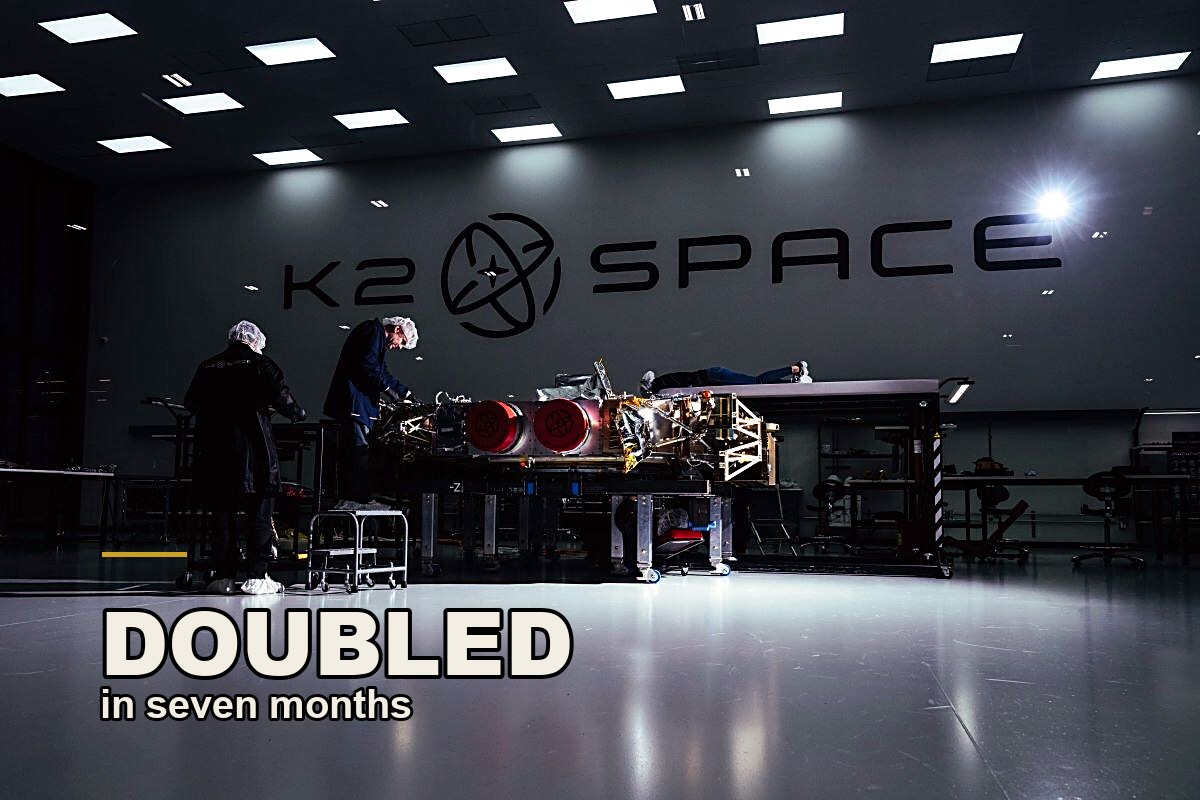
A satellite startup doubled its value in seven months. Underneath a number like that is a simple, repeatable way of growing: find the one thing most in your way, clear it, then chase the next. Most of us aim at the wrong one.
By Peter Plötner. Aerospace engineer and Wayfinder Life Coach. More about Peter →
K2 Space, a satellite startup founded by a former SpaceX engineer and his brother, just more than doubled its value in seven months. In December it was worth 3 billion dollars. By the end of July, after a fresh 500 million dollar round, 6.8 billion.
Plenty goes into a jump like that. But the engine underneath, the part you can actually borrow, is simple. A company grows at the rate it can find the single thing most in its way and remove it, then find the next one and remove that. Clear one such thing a year and the company dies. Clear one a month and you crawl. Clear one a week, one a day, several a day, and the wins start to compound.
What K2 actually built
Karan and Neel Kunjur started K2 in 2022 on a contrarian bet: build satellites that are big and, above all, powerful. Neel had spent years at SpaceX building the avionics for the Dragon capsule, so he knew what making the parts yourself buys you: speed, and the freedom to change the design whenever you need to. A K2 satellite puts out around 20 kilowatts of power, roughly 10 times a typical constellation satellite, with solar wings that unfold about 130 feet (40 meters) across. And it costs about 15 million dollars, where a conventional satellite with that much power runs closer to 100 million.
They make about 85 percent of each one themselves, in a single 180,000 square foot building in Torrance, California. The thrusters, the solar arrays, the avionics, the power systems, the flight software. A satellite-parts industry does exist, but it was built to turn out a handful of expensive, bespoke spacecraft, not to feed a factory making large, high-power ones by the dozen. Its prices and its lead times would have set K2's ceiling for it. So K2 built the parts itself.
The factory is designed to turn out up to 100 large satellites a year. It does not do that yet. It built its first full satellite in late 2025, employs a few hundred people, and is on track for around ten this year and thirty next. It is a real, running line, early in its climb. The 500 million dollars is fuel to climb faster, K2 has said the round is to grow the workforce and scale production toward that 100-a-year mark.
Solve the one that actually limits you
For a company building satellites this size and power, one thing sat in front of everything else: no outside supplier could deliver the parts at the cost and speed the whole plan depended on. That was the binding constraint, the single thing that made the business impossible until it was solved. Fix the wrong problem and nothing moves. Fix that one, and the whole thing opens up.
This is the part most of us get backwards. We solve the problem we want to solve, the interesting one, the one we are already good at, instead of the one actually holding us back. But there is usually a single constraint that makes everything else not matter, and until you clear it, effort spent anywhere else is close to wasted. K2 cleared theirs. It brought the parts in-house. And the moment it did, the constraint moved. The question was no longer “can anyone make these parts.” It became “can we make them fast enough, and hire enough people to do it,” which is exactly where the 500 million goes next.
That is what growth is. Not one heroic fix, but a chain of them. Every time you clear the thing most in your way, two things happen at once. A new constraint you could not even see before steps up to take its place. And new options open that were not available to you until now. You clear, the picture changes, you find the next binding thing, you clear that. The faster you get around that loop, the more it compounds.
Fix the one in front of you, not the one you are guessing at
Most of us also do the opposite of this, me included. It feels responsible to arm against future problems, to build the thing you might need next year, to go solve the bottleneck you think you can see coming. But you cannot know a future bottleneck is real until you are standing in front of it, and every hour spent arming for a problem that never arrives is stolen from the problem you actually have now. The discipline is stubborn attention to the present constraint. What, today, is the single biggest thing in my way. Not the fifth thing. The first.
Which one to start first
Which one you start first is a judgment call, because some constraints run on your clock and some run on someone else's. An outside yes. A reply you are waiting on. A supplier, a customer, an approval on a schedule that is not yours. You can push those only so far, because they move on someone else's priorities, not your effort, so they often set the real floor on your timeline, and they are usually the ones you keep putting off, because you cannot control how they turn out.
So the thing to weigh is lead time. How long will my own part take if I sit down and do it. How long will the outside part take once I set it moving. And how much does it actually matter. If the outside part is long and it is on the path, you want it running in the background while you work, not sitting on your desk until you feel ready. That is what K2 did with its supply chain: instead of waiting on outside suppliers it could not hurry, it built the capacity to make the parts itself, so the schedule became its own to push, with money and people.
The money itself works the same way. You do not control whether an investor says yes, or when. What you control is starting the relationship early, long before you want to raise, so they can watch you ship, miss, and recover, and so that when you do raise, you do it from strength and not because the account is running low. The rule founders repeat is to raise when you can, not when you need to. The yes is out of your hands. The head start is not.
When I decided to become a coach, my training did not begin until March 2025. But I asked for my first free client back in November 2024, months earlier, because the one part I did not control was another person saying yes, and that was the long pole. I had braced myself for 200 no's. What I had not prepared for was a yes on the very first message. It came almost right away, and it was exciting and scary.
That yes taught me the whole thing at once. The moment it landed, the constraint moved. It was no longer “can I find someone to coach.” Now it was “can I actually help the person in front of me,” so I went to work on that. Then it moved again. By the time the training began, I was not starting from zero. I already had real sessions behind me, real mistakes, and that made the training land far deeper than it would have if I had waited until I felt ready.
Try this week
Find your one constraint. Look at everything you are carrying and name the single biggest thing in your way right now, the one that, until it moves, makes most of the rest not matter. Not the fifth thing. Not the problem you would enjoy solving. The one actually holding you back.
Then ask who owns its clock. If clearing it needs an outside yes, a reply, a slow process you do not run, and that will take longer than your own part, set it in motion today. It may not feel like the most urgent thing on your desk, but urgent and limiting are not the same, and this is the one actually holding you back. Get it moving in the background while you work on what you can finish yourself.
One honest question to end on. What is the single biggest thing in your way right now, the one you keep quietly working around, and what would it take to start on it this week?
Frequently asked questions
Why did K2's valuation double in seven months?
Not because the market was hot. A company grows at the rate it can clear the one thing most in its way, then the next. K2 cleared big constraints fast in that window, and the value followed.
Did K2 really have the factory before this raise?
Yes. Its first full satellite came off the Torrance line in late 2025, months before the July 2026 round. The plant is designed for up to 100 satellites a year, though it is early in that climb, around ten this year, with the new money funding the ramp.
Isn't a big funding round always good news?
A round is fuel, not an engine. It speeds up whatever is already moving. If your real limit is something you have not cleared yet, the money just waits behind it.
How do I find my real bottleneck?
Look for the single constraint that, until it moves, makes most of the rest not matter, not the problem you would most enjoy solving. It is often the part you control the least: an outside yes, a reply, a process you do not run.
Does this only apply to startups?
No. Any goal grows at the speed you can find and clear its current limiting factor, then the next one. That is as true for a career or a coaching practice as for a satellite factory.
This is a companion piece to Integration Multiplies Opportunities and Problems, on what vertical integration multiplies once you have it. If this hit something for you, the Spec Check is four questions that take sixty seconds, a quick way to see which part of your work and life is the real limiting factor right now.
Related essays
Get new essays by email
New essays, plus the occasional thing I only send by email.