The Physics of Rock Bottom
By Peter Plötner · · 6 min read
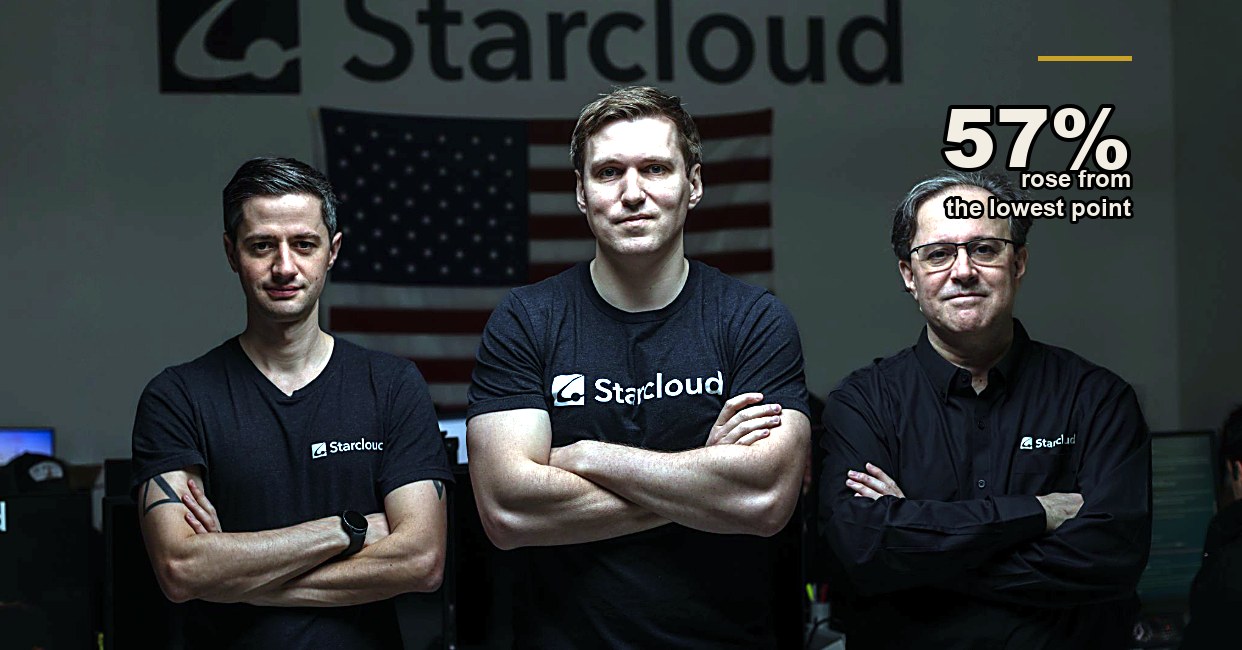
A $2.3B bet on orbit and a 25-year study of 2,420 lives agree on one rule: the lowest point of the path is where a push changes the most.
By Peter Plötner. Aerospace engineer and Wayfinder Life Coach. More about Peter →
NVIDIA just helped Starcloud, a company of 25 people, raise $250M to put data centers in orbit. Every satellite they fly will obey a rule of orbital mechanics that most of us get exactly backwards in the worst season of a life.
The news first, because it is worth a minute of wonder. Starcloud is 25 people in Woodinville, Washington. In November 2025 they flew an NVIDIA H100 to orbit on Starcloud-1, a satellite of just 60 kg. It was the first data-center-grade GPU ever to reach space, and they used it to train an AI model and to run Google's Gemini up there. In March the company was valued at $1.1B. This week, after a $250M round led by Manhattan West with NVIDIA and Cisco joining, it is valued at $2.3B. The money pays for a 100,000 square foot factory, and the CEO says they intend to ramp toward 100 satellites a week.
Smart people are still arguing about whether data centers belong in space. The rule I want to borrow from Starcloud does not care who wins that argument. It is about the shape of every orbit they will ever fly. And the same week, a 25-year study built on the University of Michigan's Americans' Changing Lives project, published in Nature Mental Health, found that people seem to run on the same shape.
Why you fire the engine at the lowest point
Most orbits are not circles. They are ellipses, stretched loops around the planet, with a highest point and a lowest point. Engineers call the high point apogee and the low point perigee. 2 facts about that loop decide how every mission is planned.
Fact 1: a spacecraft moves fastest at the bottom. At apogee, the high point, it is at its slowest. As it falls back toward the planet it trades height for speed, and at perigee, the low point, it is sprinting.
Fact 2: a burn at the bottom raises the top. If you want to lift your apogee, the highest point you will ever reach, you do not fire the engine up there. You fire it at perigee, and the far side of the loop rises.
Underneath those 2 sits the fact I love most. The same fuel buys more change the faster you are moving. Engineers call it the Oberth effect: an engine burn is worth the most at the point of highest speed. Which is the lowest point of the entire orbit. So mission planners do not treat the bottom as the sad part of the trip. They schedule their biggest burns for it. When Apollo left Earth for the Moon, the push came down low, deep in Earth's gravity well, where the ship was moving fastest.
The 25-year study that found the same shape
The study has nothing to do with rockets. Researchers followed 2,420 American adults for 25 years, drawing on Americans' Changing Lives, a national survey the University of Michigan started in 1986. They measured well-being the wide way: life satisfaction, self-acceptance, relationships, and the feeling of having a hand on your own controls.
4 paths showed up. 60% of people stayed roughly level. 8% started high and fell steeply. 2% swung up hard from very low and could not always hold the gains. And 30% started low and rose, gradually, year over year.
Here is the line worth reading twice. Among people who started at the bottom, with low well-being and real depressive symptoms, 57% rose over the 25 years. Starting low with symptoms did not predict staying down. It predicted the highest odds of marked improvement in the whole study. And starting high protected nobody: the group that fell steeply was the group that started high.
The researchers add a quiet, practical point: if you can tell which path someone is on, you can tell when help is most likely to land. Not just what kind of help. When.
What the bottom feels like from inside
From inside, a low point rarely feels like a point on a path. It feels like the end of the story. A quarter that went wrong and stayed wrong. The month the co-founder left. The morning you sit in the car outside the company you built, not wanting to walk in. If you are a founder somewhere in that neighborhood, the sentence in your head is probably some version of: so this is what it is now.
That sentence is easy to write and hard to believe from where it gets read. The data does not need us to believe it. Paths bend. And they bend upward most often for the people starting lowest.
The orbit adds the part the study cannot measure. The bottom is not just survivable. It is the single point on the loop where a push changes the path the most.
Look at why the metaphor holds. At the bottom, you are moving fast whether you chose it or not. The old plan has already broken, so there is less left to protect. Decisions you postponed for years are suddenly live this week. The people around you already expect change, so change needs less explaining. Nobody would choose the bottom, and it is not a place to wish on anyone. But if you are there anyway, this much came with it: less to lose, and more speed than any other point on the path.
The burn you have been saving
Each point on the loop has its own burn. Fire at the bottom and you raise the far side of the path, your future ceiling. Fire at the top and you raise the bottom, your future floor. That second burn is how an orbit is made round: a push at apogee lifts the low point, so the whole path stops dipping so deep. Neither burn is wasted. They do different jobs.
Most of us do neither. At the bottom we hunker down and tell ourselves everything must wait until things settle. At the top we coast and call it deserved rest. So the loop repeats, same ceiling, same floor.
The high season has a job, and it is not just enjoying the view. It is when raising your floor is affordable: take stock while nothing is on fire, and build the supports you will want in the next dip. The people you can call. The numbers you trust. The habits that hold when motivation does not. The high season is also the right place for the big dreaming, and for the same reason: a vision drawn from a steady place is drawn to scale.
Because the bottom distorts. A low state writes small dreams and desperate plans, and it will happily redesign your whole life at 3 in the morning. So the burn that belongs at the bottom is not the 10-year vision and not the dramatic leap. It is smaller and closer: the honest conversation, the ask for help, the support that changes your state. Change the state first. Decide the big things later, from a steadier stretch of the path. And that small push is still a real perigee burn: changing your state while everything is in motion is exactly the push that raises the far side.
One caveat, in plain sight. 57% is an odds line across 25 years, not a promise for any single year, and 43% of that lowest group did not rise. A low that will not lift on its own deserves real support, the professional kind, not a metaphor. Take the orbit as a reason to reach for that support sooner, not later.
Knowing where you are on the path, it turns out, matters as much as how hard you push. That is its own story for another day.
So, one honest instrument reading, no judgment attached. Where on the loop are you right now: a high stretch, a low one, or somewhere between? If it is high, raise a floor while it is affordable. If it is low, make the small burn that changes your state. The conversation. The ask. The support. The physics will do what it has always done: a push at the bottom raises the far side of the path.
Frequently asked questions
What did the new well-being study actually find?
Researchers followed 2,420 US adults for 25 years as part of the Americans' Changing Lives project, which began in 1986. Well-being followed 4 paths: stable (60%), gradually improving from a low start (30%), declining steeply from a high start (8%), and volatile (2%). Among people who began with low well-being and elevated depressive symptoms, 57% rose over the 25 years, the highest odds of marked improvement in the study. It was published in Nature Mental Health in August 2026.
Why do spacecraft fire their engines at the lowest point of an orbit?
2 reasons. A burn at the low point, called perigee, raises the opposite side of the orbit, so it is how you lift the highest point of your path. And because a spacecraft moves fastest at perigee, the same fuel buys more energy there, an advantage engineers call the Oberth effect. A burn at the high point has its own job: it raises the low point, which is how an orbit is made round.
Does hitting a low point guarantee things get better?
No. The 57% figure is about odds over 25 years, not a promise, and 43% of that lowest group did not rise. The essay's point is smaller and more useful: a low point is a place on the path, not the end of the story, and it carries unusual leverage. If a low will not lift on its own, that is the moment for real support, including professional help, not for waiting.
What is Starcloud and why did it raise $250M?
Starcloud is a 25-person company in Woodinville, Washington that builds data centers in orbit, where solar power is continuous and heat can be radiated away to space. In November 2025 its Starcloud-1 satellite carried the first data-center-grade GPU, an NVIDIA H100, into orbit, trained an AI model, and ran Google's Gemini in space. This week it raised $250M at a $2.3B valuation, led by Manhattan West with NVIDIA and Cisco joining, to scale manufacturing toward a planned 100 satellites a week.
I am a founder in a bad quarter. What does firing at the bottom mean in practice?
Keep the burn small and aim it at your state, not your strategy: the honest conversation, the ask for help, the support that steadies you. A low state distorts big plans, so save the 10-year vision for a steadier stretch. And when a high season comes, use it to raise your floor: take stock and build supports, so the next low is less low.
One thing that closes soon. I just earned my certification as a Wayfinder coach, and to mark it I am giving away my full 3 month coaching package to 1 person, free. It is the same package paying clients get: a session every 2 weeks, support in between by message or voice, and the method itself, so you can run it again on your own later. No homework. I read every application myself and they close on September 20. If this essay found you somewhere near the bottom of an orbit, the application is here and takes about 5 minutes.
The companion pieces are Grounded Is Not Broken on what a forced pause really is, and Most Things Aren't Broken. They're Out of Fuel. on telling an empty tank from a broken engine. If you want a first instrument reading on your own orbit, the Spec Check is 4 questions and takes about a minute.
Related essays
Your space, free
No matter where you start, it walks with you: find what you really want, and be at peace and in joy on the way. Your unfair advantage.
Make my free account