It Works. It Costs You Both Hands.
By Peter Plötner · · 6 min read
The FDA just cleared the first walking robot for home use that balances itself. What took 12 extra years was not the walking. It was giving the person their hands back.
By Peter Plötner. Aerospace engineer and Wayfinder Life Coach. More about Peter →
For 12 years, every walking exoskeleton cleared for use at home worked by borrowing both of the user's arms. On August 11 the FDA cleared the first one that does not. The design choice underneath it is one you have probably made in your own company without noticing.
The machine is called Eve, and it is built by a French robotics company, Wandercraft. It is a wearable robot for adults living with a spinal cord injury, at any level, and it is self-balancing. No crutches. It goes on sale in the United States on September 17.
Self-balancing sounds like a small feature. It is the entire story.
What the machine took over
A person on two legs is not stable the way a chair is. Standing still is already a balancing act, and walking is a controlled fall that you catch, step after step, without ever thinking about it. Build a machine that walks and you inherit that problem. Something has to do the catching.
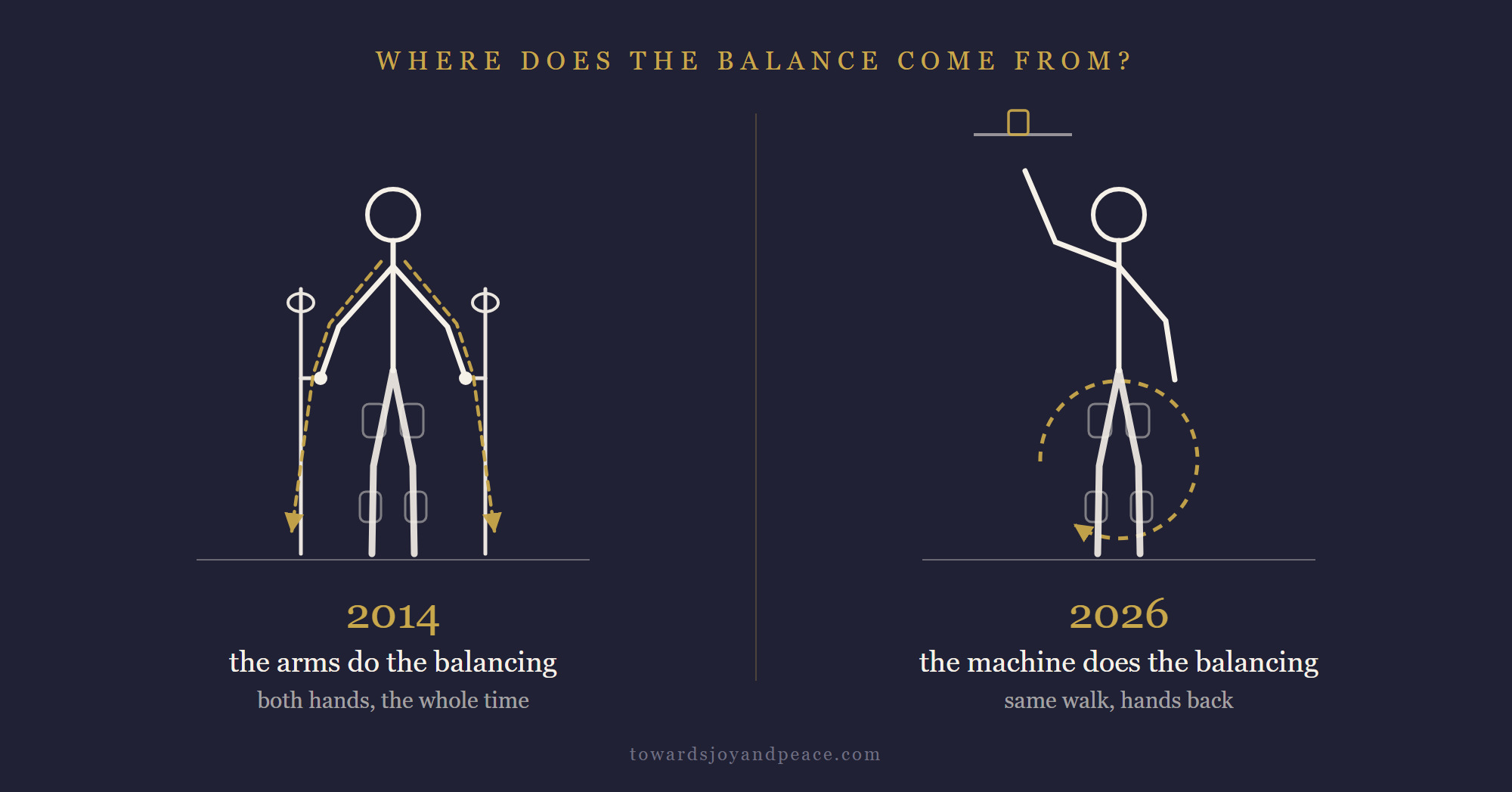
The first generation gave that job to the person. ReWalk was cleared for home use on June 26, 2014, the first of its kind. Ekso Bionics' Indego followed. Both are real, both work, and both are used with two forearm crutches. The robot moves the legs. The arms keep the whole thing from tipping over.
Eve does the catching itself. The person picks a move on a small handheld control, walk, turn, squat, and the robot handles staying upright. Wandercraft had already pulled this off in clinics with an earlier machine, Atalante X, now in more than 150 rehabilitation centers. Doing it in someone's house is the new part, and houses are harder than clinics: rugs, thresholds, a kitchen, nobody on staff.
The clearance is narrow. Level floors indoors, plus level ground right outside the building like a patio or terrace. A specially trained companion has to be there. Training is 5 sessions of 2 hours. This is not a machine you take hiking. It is a machine you live in at home.
The requirement nobody wrote down
Every one of these machines was built against the same requirement: the person must be able to stand and walk. The crutch design meets it. It passes the test. For a lot of people it has been life changing, and a crutch version you can afford beats a perfect version that does not exist.
Now look at what it spends. Both hands, the entire time you are upright. You can walk to the kitchen and carry nothing back. You can reach a door and not be able to open it. You cannot hold a cup, or a child's hand.
Caroline Laubach is 22 and one of the people who tested Eve. Asked what changed, she did not talk about walking. She talked about having conversations eye to eye, and getting a cup down from the highest kitchen cabinet. To a reporter in New York she said something I keep thinking about: “Every time I get up I remember how tall I really am.”
The walking was never the point. The point was everything a person does while they happen to be upright. So the missing requirement was never about legs. It was about what the fix is allowed to use up.
Somewhere in your work, you are the crutches
The people in this story are not a metaphor. The design choice is.
If you build things for a living, you have shipped this exact design more than once. Something in the company wobbles. Handoffs drop. Quality slips. A new hire is not up to speed yet. And you steady it with your own arms: you join the call, you become the last approver, you hold the thread in your head because the system will not hold it for you.
Then it works. That is the part that makes it permanent. Nobody goes back and reviews a fix that works. It never becomes an incident, never lands on a list, never gets a retrospective. The cost does not show up as a failure. It shows up as capacity you no longer have, quietly, every single day the thing stays upright.
If you started the company you run, this is the calm early version of being the single point of failure. Long before anyone says the word, there is just a founder whose hands are full.
Moving the balancing into the system
The fix is not better crutches or a stronger grip. It is moving the balancing job out of the person and into the thing itself.
That is a much harder engineering problem, and the 12 years are the proof. Propping something up is simple. Teaching it to catch itself means sensing, deciding, and correcting faster than it can fall, and getting that from a clinic floor into a living room took years of work and a $75 million funding round in June 2025.
In a company the same work is unglamorous and mostly writing. Put the decision rule you have been running in your head into words other people can use. Hand over the authority, not just the task. Build the check that catches the mistake you have been catching by eye. None of it feels like progress on the day you do it, and all of it is the same move: the balancing stops running on you.
There is a harder version of this question that I am not going to open here, the one where the thing holding it up is not your hands but your name on it. That one deserves its own essay.
What is holding it up?
The habit I took from this is small. When something in your work is standing up and running fine, do not just check that it works. Ask what is holding it up, and then ask what that support is costing.
The strong version of the question is physical, and it takes about a minute. Pick one thing that is going well right now. Imagine taking your hands off it completely for 2 weeks. Not delegating it properly, just letting go. What tips over first? Whatever answers is the crutch, and it is running on you.
A machine that walks is a lovely headline. What Wandercraft actually shipped is a machine that stopped charging people their hands for it.
Frequently asked questions
What is Wandercraft's Eve exoskeleton?
Eve is a wearable walking robot for adults living with a spinal cord injury at any level, cleared by the FDA on August 11, 2026 as the first self-balancing personal exoskeleton. It keeps the user upright by itself, so no crutches are needed, and it is steered with a small handheld control. The United States launch is set for September 17, 2026.
How is Eve different from ReWalk and Indego?
Personal exoskeletons are not new. ReWalk was cleared for home use in June 2014 and Ekso Bionics' Indego followed. Both move the legs but rely on the user's forearm crutches for balance, which occupies both hands and both shoulders. Eve does the balancing in software and hardware, so the hands stay free for ordinary things like carrying a cup or opening a door.
Where can Eve actually be used?
The clearance covers level indoor surfaces and level outdoor areas attached to the building, such as a patio or terrace, with a specially trained companion present. Users complete 5 training sessions of 2 hours. Wandercraft has an established Medicare billing pathway from its clinical machine and expects Medicare eligibility for Eve within 60 to 90 days of clearance.
What does self-balancing actually mean?
Walking is a controlled fall. Every step, a body starts to tip and catches itself. A self-balancing robot does that job on its own: it senses how it is tipping and corrects faster than it falls. Earlier home exoskeletons skipped that problem by handing the balancing to the user through crutches, which is far easier to build and much more expensive for the person wearing it.
How does this apply to my work or my life?
A fix that works can still be expensive if it runs on you. When you hold a process together by joining every call or approving every decision, the thing stays upright and your capacity is spent keeping it there, with no failure to show for it. Ask what is holding each working part of your life up, and what that support costs. Then move the balancing into the system: write the rule down, hand over the authority, build the check.
This is a cousin of Stop Optimizing Your Life. Start Specifying It., which is about writing the requirement down in the first place. If you want a quiet way to see which parts of your life are running on your own two arms, the Spec Check is 4 questions and takes about a minute.
So here is the one to sit with. What in your work is standing up right now only because your hands are on it, and what would you do with those hands if they were free?
Related essays
Your space, free
No matter where you start, it walks with you: find what you really want, and be at peace and in joy on the way. Your unfair advantage.
Make my free account